T Shaped Transformations

I often hear alpha type leaders tell me with pride that they intend to fire those that do not get on board with their plans for transformation. This is not an act of courage and decisiveness but rather a failure in leadership. Very few people come to work with the intent to do poor work or sabotage change efforts. When there is resistance there is a reason. There are real and perceived barriers preventing people embracing the transformation. Barriers that have been put, or left, in place by the same leaders who are so eager to fire the change laggards. It is an essential leadership responsibility to create the right environment that dissolves resistance and nurtures enthusiasm. Sustainable transformations require everyone to feel they are equipped, enabled and empowered. At the same time the program needs to deliver results. This is not an easy leadership task – harder than simply firing the people “getting in the way”.  How to make this happen? Design a program that is T-shaped.

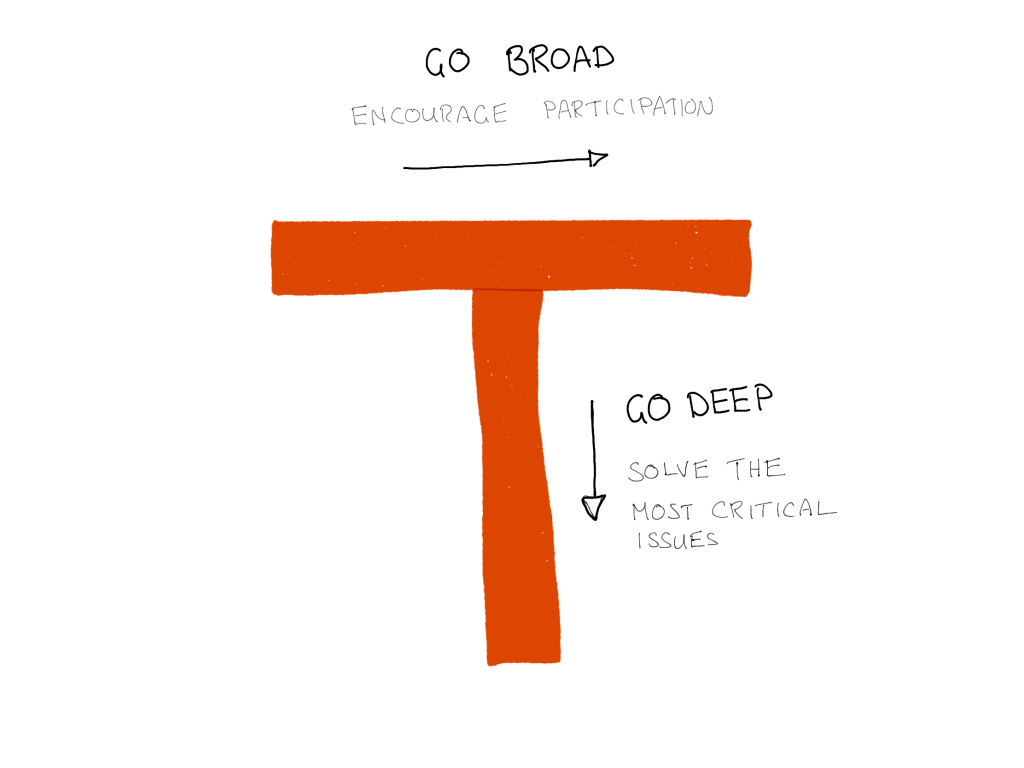
A T shaped transformation has 2 components…

The first is the broad top section of the T. In a T-shaped approach, change programs are designed to engage the breadth of the organisation. It is important to lower the barriers to entry, reward participation over outcome and develop a feeling of contribution to the overall results. At DBS when we started our decade long transformation we created a program of improvement workshops called Process Improvement Events or PIEs. No pre-requisites were required. Training was given as part of the workshop, people were empowered to make change and ideas were implemented immediately. We created an iconic success measure for the program – the customer hour – a measure of customer waiting time whether it be in branches, at ATMs or receiving new credit cards. It was something everyone could contribute to and was a fantastic way of communicating progress. Rather than auditing the outcomes we recognised people for having the courage to participate. Over 2 years we ran 200 workshops reducing overall waiting times by 250 million hours per year – if you go back in time 250 million hours you end up in the stone age – it was a lot of time. Our customers noticed the difference and we went from the bottom of the customer satisfaction scores to the top in the space of 12 months. 

The second part is to go deep. Leaders choose 5 – 10 areas that are most critical and apply management oversight and investment. At DBS we identified the Big 6 – the six most urgent areas for us to fix our customer service. We put dedicated teams in place, top level governance and investment.

This two pronged approach yielded results. We improved the service in each of the Big 6 focus areas. A couple of years after starting we went back and reviewed each of the PIEs to ascertain how many had actually delivered results. We were delighted to find that around 75% had had a significant impact on reducing waiting times. More importantly we had unlocked the passion of the company and we now had an army of people enthusiastic about, and capable of, driving change. We had built the foundation of the success that would follow. The T-shaped approach became the template for all the subsequent transformation programs we ran.  And we never fired anyone for not getting on board.
Leadership Lessons

If you experience resistance from some of your people the chances are that you have not created the right environment.

For a sustained transformation you will need to engage everyone and unlock their passion through a program designed to both engage and deliver results.

Define success and communicate progress by creating iconic measures that everyone can contribute to.
The System Always Wins.

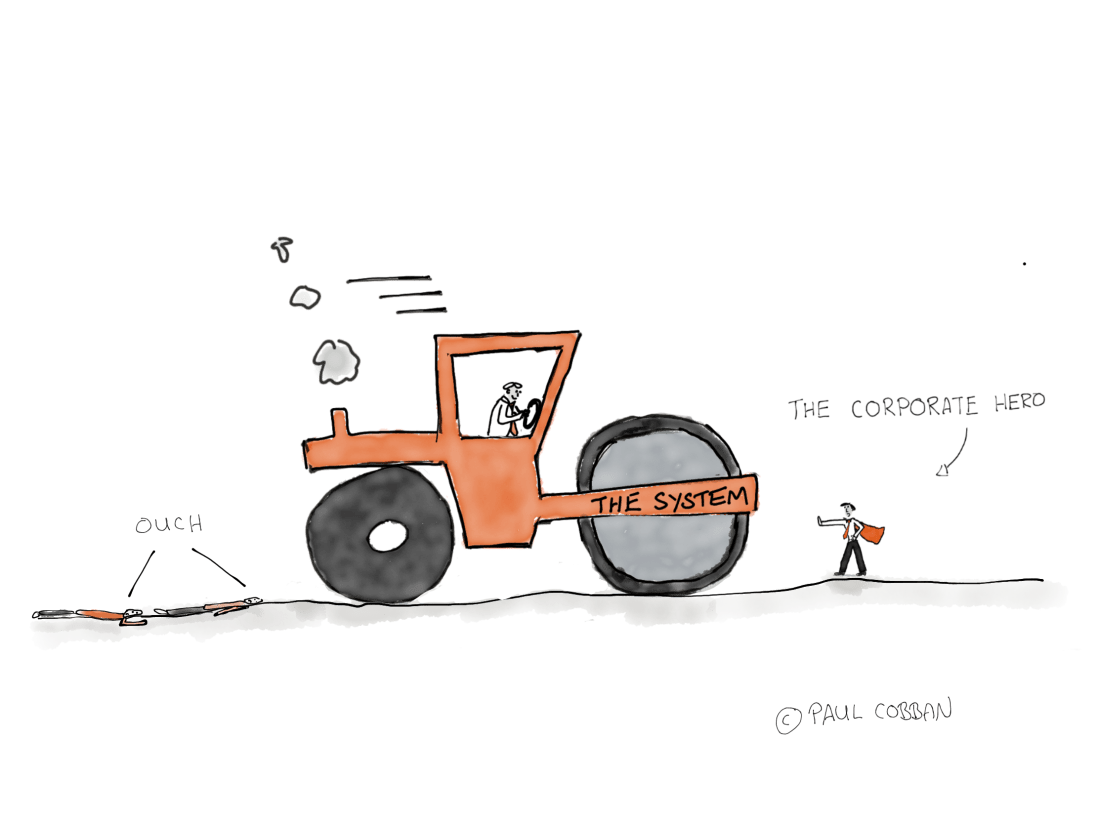
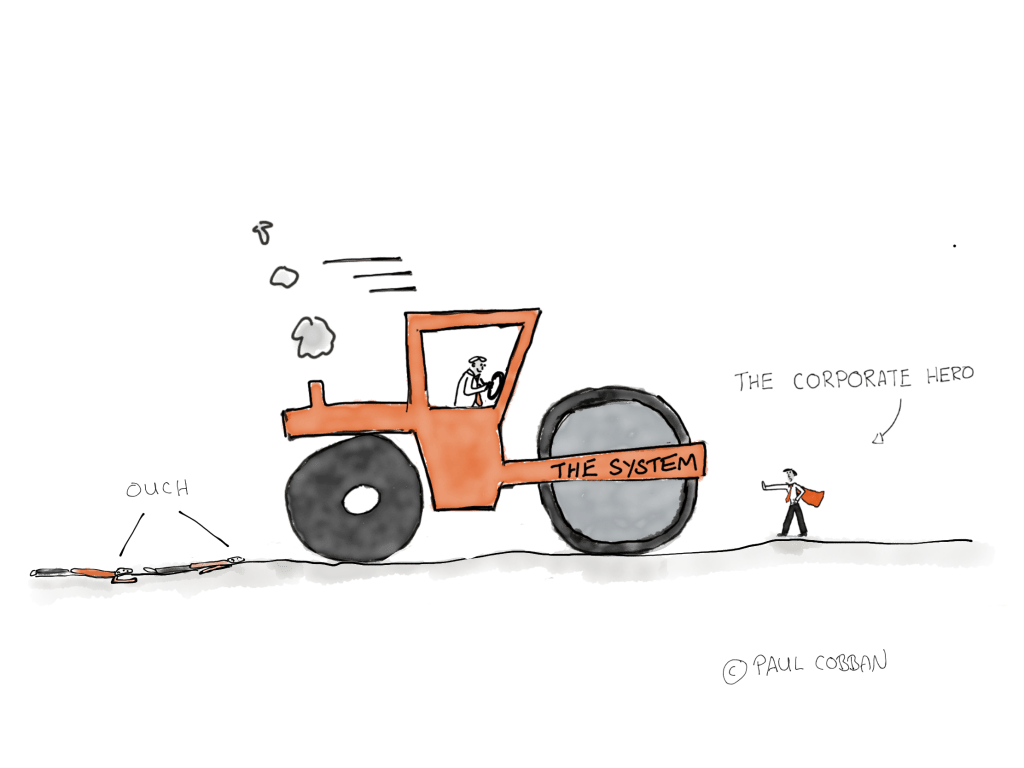
“When a great person takes on a bad system the system always wins”. Frank Voehl. The internal systems and processes of legacy companies are designed to protect the status quo and when left unchanged, present insurmountable barriers to any significant and sustainable transformation. The way investment decisions are made, the way people are hired and rewarded, how resources are allocated even where people physically sit (remember that?) all promote inertia. Since the system always wins, leaders of transformation need to change the system rather than blame the people.  But why is it so hard?

Back in the sixteen century Nicolaus Copernicus challenged the universally held belief that the Earth was the centre of the universe by claiming the Earth, in fact, revolved around the Sun. His ideas were met with ridicule and accusations of blasphemy and only after his death were his ideas accepted. With the benefit of hindsight it is easy to snigger at the ignorance of the people of the time. However it is very difficult to convince anyone that their deeply ingrained beliefs are incorrect. Yet it is often these beliefs that hold us back. I am not sure if we would not have put a man on the moon had we not accepted Copernicus’s heliocentric view.

As a transformation leader it was my job to challenge traditional and ingrained corporate processes that were getting in the way. Over the past decade I have suggested that: 

  • there are better ways other than interviews to select the best talent
  • personal objectives and KPIs drive the wrong behaviour and need to be supplemented with team targets 
  • job grades create unnecessary hierarchies and should be abolished
  • we should not sit together by department but by how the work gets done 
  • we should align the organisation to optimise for customer experience rather than the convenience of the bosses
  • we do not need an annual budget and planning process

Every time I raised these suggestions I was greeted in a way that Copernicus would have recognised. This was naive on my part (I should have learnt from Copernicus who was apparently quite cautious). I learnt that challenging such beliefs head on and getting frustrated was not sensible. It did not yield results and I realised that I needed to change my approach. After all, I also held ingrained beliefs that would be a challenge for anyone else to alter. So over many iterations with the help from my team, we developed a new approach. One that was less confrontational and when adopted, yielded better outcomes. With the exception of one (I will leave you to guess) we were able to at least partially implement the suggestions referred to above. Here are the some of the components of the approach we developed using the hiring process as an example.

Be clear about the purpose and success criteria of the corporate process and list assumptions.  

It is easy to forget the intent of a deeply ingrained process and we seldom check to see if the approach is working. For example the desired outcome of the hiring process is to attract and hire the very best people for the job. There is an assumption that the interview process is the best available way to select the best people.

Determine how to measure the effectiveness of the process

In the case of hiring we looked at the performance measures of new hires (although this in turn can be questioned)

Run an alternative approach 

We designed a hackathon event where IT candidates were invited to join internal developers in creating solutions to real problems over a 48 hour time frame where we could observe the candidates in action as well as assessing their technical capability first hand.

Leadership Lessons

Protect your Copernicuses.  Every company has people with radical ideas. If you do not see them you have not created an environment of psychological safety.  Search them out and encourage their suggestions.

Be open to try new things.  As a leader never dismiss ideas including the radical ones.  Help to unpack suggestions to their outcomes and assumptions. Then experiment with an open mind.

Measure.  Be clear how you are going to measure success.  If you cannot measure you cannot know whether the incumbent process is superior to the challenger.