Digital to the Core

In mid 2015 a group of executives were huddled in a windowless Mumbai conference room debating how to overcome what many believed to be an insurmountable challenge. Half the room were bankers, the rest were an eclectic mix of entrepreneurs, transformation specialists and designers. The bankers were adamant that the task in hand was not possible – the regulations were too onerous and the infrastructure too immature. The non bankers, unencumbered by careers of interactions with banking regulators, were sure that it could be done. The task? To launch the first fully digital bank in India. A bank where customers could open an account without visiting a branch. A bank that could be run with 10% of the staffing levels of a conventional bank. A bank that was not just a fancy front end app supported by armies of humans, but fully digital from end to end. The team needed a new approach if they wanted to move forward. What unfolded in that room changed the course of the project.

The team tried a workshopping technique called “back-casting” that involved designing the implementation from the future back rather than from the present forward. The team described precisely the new bank’s future customer experience and operation model and then defined the bold steps that needed to be taken to get there. The technique had been designed specifically to help teams overcome big challenges. Coming out of the exercise were three stand-out principles that proved to be pivotal.

It was clear to the team that the new bank needed to be digital to the core. They could not simply apply “digital lipstick”. In order to scale, all processes needed to be digitally automated. There could be no manual hand offs to the operations teams. There could be no residual manual steps for the back office planned to be fixed later and then forgotten. In addition the customer journey had to been frictionless but could not rely on a branch network. This meant working with technology partners who could provide solutions in three areas – natural language processing AI for a sophisticated chat bot, security software to allow digital onboarding and a financial management capability. To take advantage of the AADHAR biometric verification system that had recently been implemented by the forward-thinking Indian government, the team decided to partner with an Indian coffee shop chain where customers could use thumb scanners to verify their identity and also get a free cup of coffee.

Like product companies that “design for manufacturer”, the bank recognised the need for products and journeys to be designed with operations in mind . To optimise for productivity and risk the operations teams were included in the design stage to ensure products were “designed for operations”. For the new bank this approach was not going to be good enough. The bank needed to be run with a staffing level a small fraction of that of a traditional bank. The team realised they needed to design for no operations. Processes had to be straight-through. Products had to be standard and simplified to eliminate the exceptions that drive manual processing.

Similarly the new bank needed a customer support model that not just reacted to customer problems but predicted and prevented them. Best in class customer service units focus on dealing in with customer queries completely at the time of contact and “first call resolution” is recognised as the metric that drives customer satisfaction. However the team realised that they needed to create a level of reliability and ease of use where customers did not need to call at all. The team introduced the concept of zero call resolution – involving frictionless customer journeys and the use of AI to predict problems before they occurred. The team set themselves a challenge of preventing 1 million customer problems before they occurred.

Breaking the larger problem down in these concepts energised the teams. More traditional problem solving techniques could then be employed. Not only were the concepts the foundation of the new bank in India which was launched less than a year later but also were retrofitted into the existing digital offerings in the more developed markets.

Leadership Lessons

Starting with the end in mind and defining the key steps together helps to overcome seemingly impossible barriers.

Eclectic teams are more likely to have the belief and creativity to drive ambitious innovation.

Breakthrough solutions can be usually be applied beyond the current solution.

If you enjoyed this post feel free to subscribe and you can receive the next post direct to your inbox

Are you Future Ready?

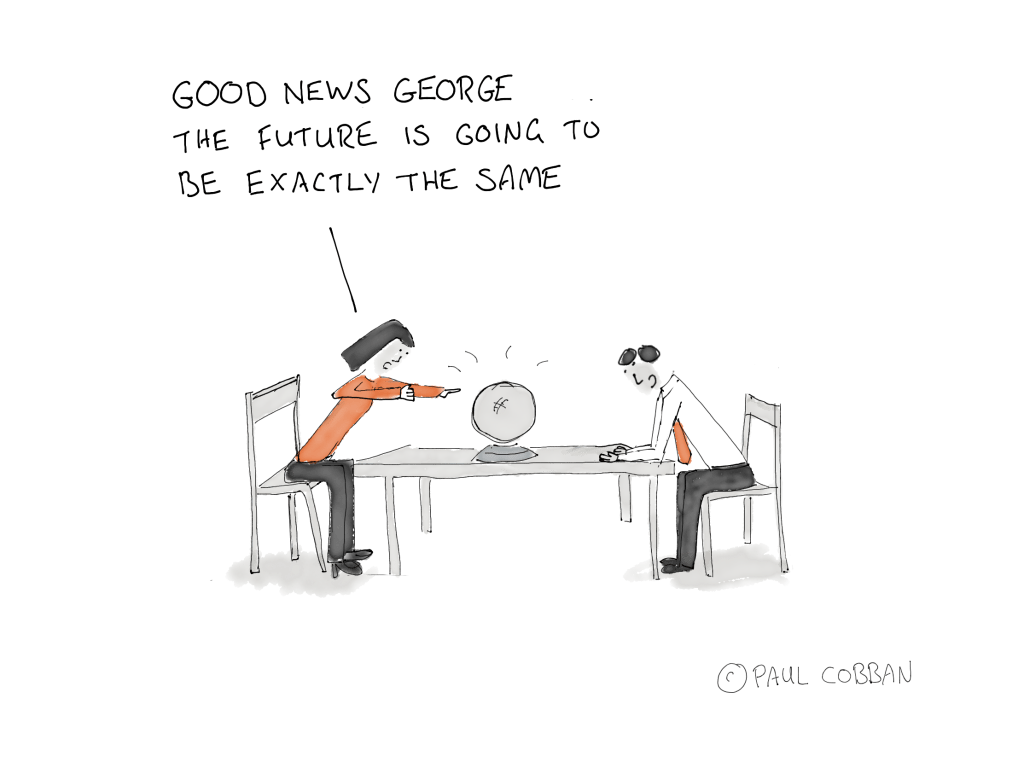
Companies that execute successful transformations seem to be able to predict the future better than others. They spot trends early and are able to make informed investment decisions that give them a head start developing innovative solutions. Do they employ psychics or have leaders with superpowers? Clearly not. It is because they follow a structured approach to understanding the future. 

There has been a lot said about agility and the need to sense and respond. Being able to quickly adapt to changes is an essential component of being prepared for the future. However not enough companies focus on improving the time it takes to sense trends.

Like everything in life to get better at something you need to put in the time. Reading articles on the plane (remember that?) isn’t going to be enough. Best in class leaders allocate significant amounts of time with their top teams getting inputs from world class thought leaders, deep subject matter experts as well as the views of their own people. Based on these inputs leading companies develop an informed view of what they collectively believe the future holds in 5, 10, sometimes even 100 years out.  With this in place informed investments can be made to best prepare for the predicted future.

It is important to remain focused on the emerging trends that are going to be relevant to the business. There is going to be hype and it is very easy to get sucked in. If you cannot see line of sight on how a new technology is going to help improve the lives of your customers or solve a business problems, park it for now and revisit. When blockchain first emerged it felt that all of the world’s problems were going be solved but to date only a tiny fraction of use cases ended up solving real problems.

While I was at DBS we spent 3 days every year with the CEO and top team focusing on the emerging trends, getting the views of the world experts, studying the best in class across all industries and asking our own people for their views. The majority of the time was spent debating the relevance of trends to the business and selection experiments to run to learn more.  

In addition each business area went through a back-casting exercise based on a board game we created called North Star where leadership teams visualised the future by prioritising a series of pre-canned technology, macro social-economic and industry statements (eg 80% of cars will be autonomous, average life span will be 110)  in terms of probability to be true in 10 years and relevance to their respective businesses. The teams then decided what areas should be invested in over the next 12 months to prepare for the predicted 10 year view. A proportion of the annual investment budget was then allocated to creating experiments to test feasibility and viability of the ideas. This resulted in a more ambitious innovation strategy.

However, there is one big danger out there – the HIPPO or Highest Paid Person’s Opinion.  No-one can completely predict the future. Those that do just are lucky. The leading innovative companies consistently estimate that one idea in 20 is a good idea. Therefore you have 95% chance of getting it wrong. Therefore you should expect to be wrong. However it is not uncommon for the entire workforce to pivot to something that the leader has said in passing in a meeting. Egos and ignorance can make it tough to change course. Therefore companies pursue what Scott Anthony would call “zombie projects” too long. Best in class companies build a culture where each idea is treated as imperfect and is tested and tuned through experimentation and data.

Leadership Lessons

Spend time as a leadership team getting inputs from all quarters to make an informed view of the future

Make sure that the focus remains on future trends that are most relevant to the business and customers and make the relevant investments now to best prepare for your predicted future.

Expect to be wrong.  No-one can accurately predict the future so you need to continually check that ego driven beliefs are not taking the company in the wrong direction.

If you enjoyed this post please add your email here and you will receive the next post directly to your inbox.

Being Data Driven

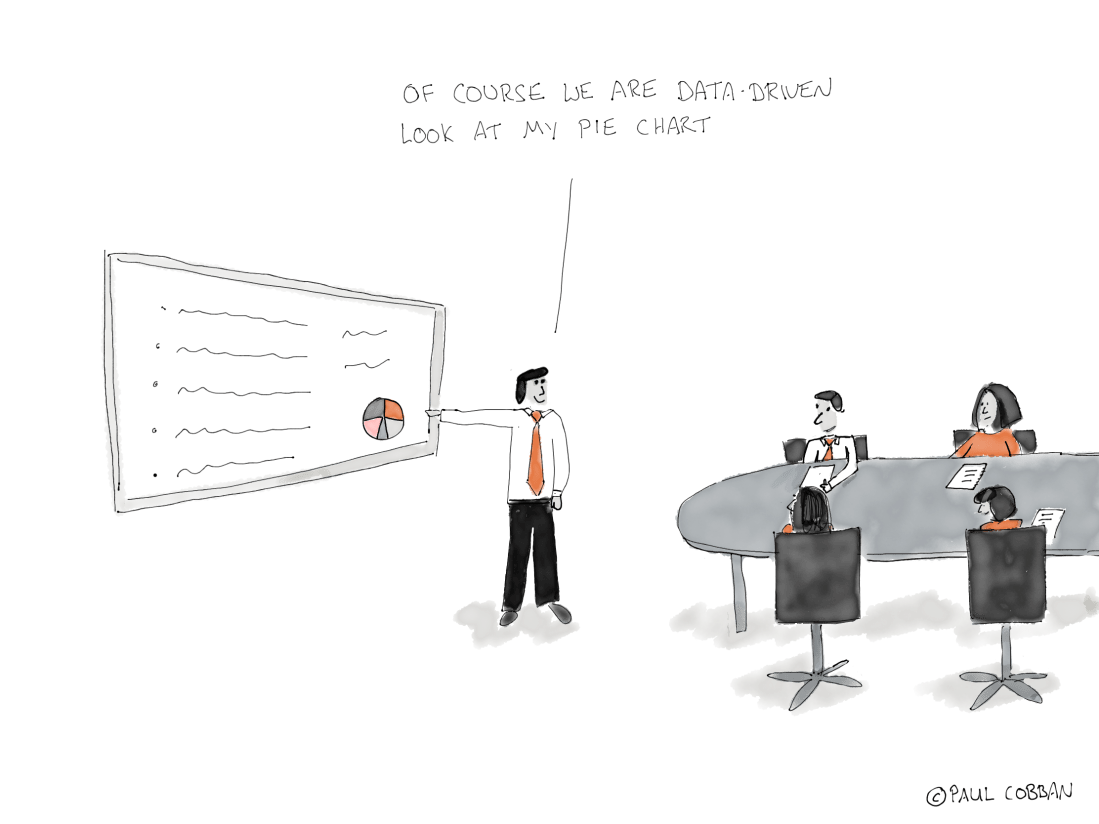
One swallow does not make a summer (a fact that I have found to be oh so true since relocating to Edinburgh!) nor does one pie-chart in a powerpoint make you a data driven company. When I became Chief Data Officer at DBS in 2016, I was tasked with making DBS “data driven”.  How hard could it be?  We had several successful transformations under our belts and surely this one would be just a rinse and repeat. As it turned out it took me three years simply to figure out what a data driven company actually was and then getting to be one was the biggest challenge we had ever faced.

Prior to 2016 we had been operating as a “powerpoint driven” company where decisions were taken in meetings by the most senior person in the room based on the content of a slide deck. So when I took on the role I asked many leaders within and outside DBS what they considered a data driven company to be. I was told that data was the new oil or water or even blood. People referenced TV shows and movies – Minority Report anyone? Every software vendor claimed that Artificial Intelligence was embedded in their products – data was clearly becoming the new snake oil. Of course as soon as we announced our intent to be data driven there were claims that we were already data masters – “We are a bank – we use numbers all the time”, “Look at the pie chart in my powerpoint”. We knew we had to do some heavy lifting in terms of addressing data quality, bringing all the bank’s data into a new tech data platform, investing massively in training and attracting the best talent. However we did not have a clear view of what the end state looked like.

Three years down the line it felt like we were in good shape – most of our data was of high quality, referenced with metadata and residing in a leading edge data platform. We had trained huge amounts of people and attracted some great talent. Because we adopted our tried and tested approach of encouraging people to just dive in and have a go, we had over 100 projects underway and were starting to deliver real benefits. However what we really had was just a bunch of projects. We were not running the company day to day using data. Powerpoints still ruled the roost.

Then the epiphany came. We were inspired by the evolution of data use in Formula 1 Motor Racing. Over the past few decades the sport had gone from using signboards at the side of the track to sophisticated instrumentation on the cars that transmit huge amounts of data during the race to allow the pit-wall crew to make real time adjustments to strategy. In between races experimentation and data analysis’s results in continuous incremental improvement. We asked ourselves what would it take to run our business this way.

We realised that to be data driven we needed to completely re-imagine how to run the company. Despite the progress we had made, this final step was going to be the largest and toughest. We needed a new approach so we developed the following 5 steps:

  1. Be ultra specific about what constitutes success of the business. What is the exact outcome measure that needs to optimised. In F1 it is obvious: “Did you win the race?”. In business it can be less clear. Through discussions on outcome measures we highlighted some mis-alignments in our strategies that we were able to iron out.
  2. Identify 3-5 drivers that have the biggest impact on the outcome. I am no expert but I would imagine winning a F1 race is impacted by engine performance, tyre strategy, driver capability, pit stop timings etc. In business there can be a tendency to analyse the outcome – in review meetings leaders tend to drill down on revenues by geography or product rather than focus on what they can influence i.e. the drivers. Furthermore there is scant thinking about the relationship between the drivers and the outcome. If training improves the performance of a sales team, what kind of training works best and by how much? A data driven company seeks to continually improve their understanding of the causal relationships between drivers and outcomes.
  3. Identify opportunities to apply machine learning to improve the drivers’ impact on outcome. Machine learning can beat humans in predicting outcomes given the right data. Therefore developing models that take some of the guesswork out of people’s job makes sense. Who is the best customer to call next? Does this transaction look suspicious?
  4. Relentlessly experiment to test hypotheses. In order to continually optimise, previously held beliefs need to be challenged. A data driven company is an experiment machine and focuses on accelerating the speed of learning by investing in experimentation infrastructure, processes and training. Which leads to the big one….
  5. Change the leadership culture to start asking questions rather than giving answers. The big tech companies who excelled in an experimentation-led approach consistently told us that only 1 in 20 hypotheses are proven to be correct and therefore leaders should expect to be wrong. A HIPPO culture where the HIghest Paid Person’s Opinion always wins results in learning opportunities being blocked. We therefore encouraged leaders to ask 2 questions of their teams. “What experiments are you running next?” and “What did you learn from the last set of experiments?”. Oh and this helps create a culture of psychological safety – an essential ingredient for innovation.

Leadership Lessons

  • Spend an inordinate amount of time aligning leadership understanding of what is meant by “being data driven”.
  • Focus on improving drivers and not acting directly on outcomes.
  • Expect to be wrong and therefore focus on test hypotheses through experimentation.
  • Becoming data driven is a culture shift more than an investment in technology, process and data scientists.

The System Always Wins.

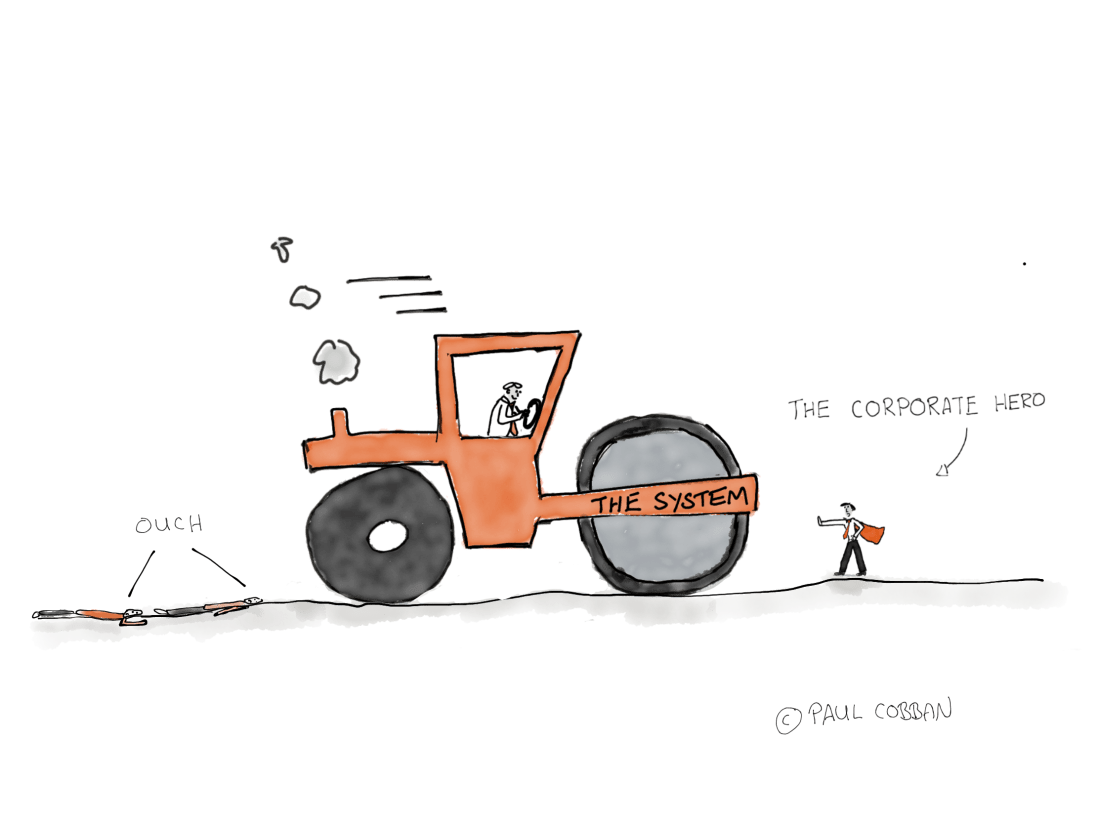
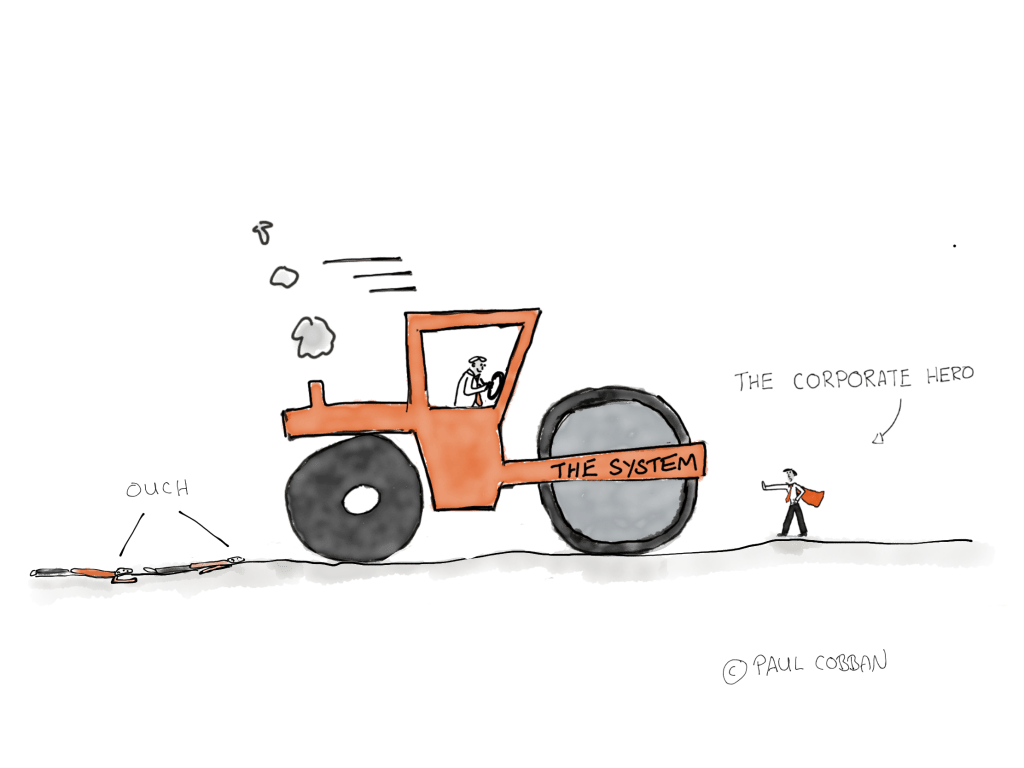
“When a great person takes on a bad system the system always wins”. Frank Voehl. The internal systems and processes of legacy companies are designed to protect the status quo and when left unchanged, present insurmountable barriers to any significant and sustainable transformation. The way investment decisions are made, the way people are hired and rewarded, how resources are allocated even where people physically sit (remember that?) all promote inertia. Since the system always wins, leaders of transformation need to change the system rather than blame the people.  But why is it so hard?

Back in the sixteen century Nicolaus Copernicus challenged the universally held belief that the Earth was the centre of the universe by claiming the Earth, in fact, revolved around the Sun. His ideas were met with ridicule and accusations of blasphemy and only after his death were his ideas accepted. With the benefit of hindsight it is easy to snigger at the ignorance of the people of the time. However it is very difficult to convince anyone that their deeply ingrained beliefs are incorrect. Yet it is often these beliefs that hold us back. I am not sure if we would not have put a man on the moon had we not accepted Copernicus’s heliocentric view.

As a transformation leader it was my job to challenge traditional and ingrained corporate processes that were getting in the way. Over the past decade I have suggested that: 

  • there are better ways other than interviews to select the best talent
  • personal objectives and KPIs drive the wrong behaviour and need to be supplemented with team targets 
  • job grades create unnecessary hierarchies and should be abolished
  • we should not sit together by department but by how the work gets done 
  • we should align the organisation to optimise for customer experience rather than the convenience of the bosses
  • we do not need an annual budget and planning process

Every time I raised these suggestions I was greeted in a way that Copernicus would have recognised. This was naive on my part (I should have learnt from Copernicus who was apparently quite cautious). I learnt that challenging such beliefs head on and getting frustrated was not sensible. It did not yield results and I realised that I needed to change my approach. After all, I also held ingrained beliefs that would be a challenge for anyone else to alter. So over many iterations with the help from my team, we developed a new approach. One that was less confrontational and when adopted, yielded better outcomes. With the exception of one (I will leave you to guess) we were able to at least partially implement the suggestions referred to above. Here are the some of the components of the approach we developed using the hiring process as an example.

Be clear about the purpose and success criteria of the corporate process and list assumptions.  

It is easy to forget the intent of a deeply ingrained process and we seldom check to see if the approach is working. For example the desired outcome of the hiring process is to attract and hire the very best people for the job. There is an assumption that the interview process is the best available way to select the best people.

Determine how to measure the effectiveness of the process

In the case of hiring we looked at the performance measures of new hires (although this in turn can be questioned)

Run an alternative approach 

We designed a hackathon event where IT candidates were invited to join internal developers in creating solutions to real problems over a 48 hour time frame where we could observe the candidates in action as well as assessing their technical capability first hand.

Leadership Lessons

Protect your Copernicuses.  Every company has people with radical ideas. If you do not see them you have not created an environment of psychological safety.  Search them out and encourage their suggestions.

Be open to try new things.  As a leader never dismiss ideas including the radical ones.  Help to unpack suggestions to their outcomes and assumptions. Then experiment with an open mind.

Measure.  Be clear how you are going to measure success.  If you cannot measure you cannot know whether the incumbent process is superior to the challenger.