The Biggest Silo of them All

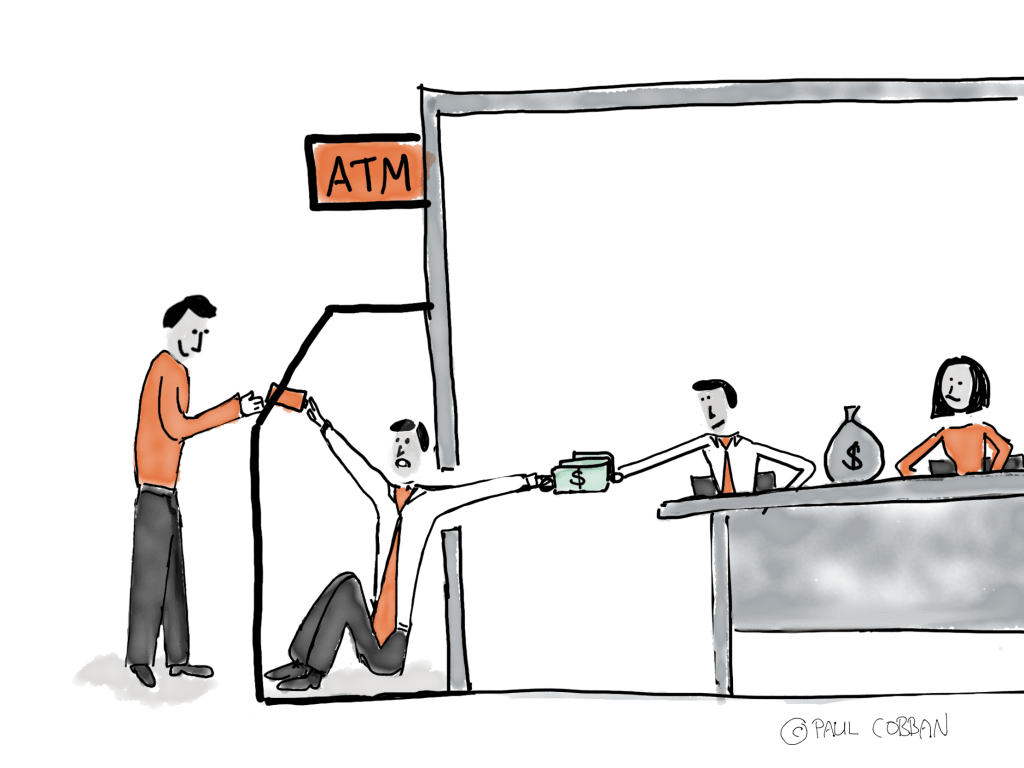
What happens in your company when IT systems fail, software development projects are late or there is a data breach?  Do the business people indignantly escalate the issues to the IT department? Do they write angry emails to the CIO?  If that is the case and you aspire to be a digital company then you have a problem. Such friction between business and tech teams is indicative of a company that does not realise what it means to be digital and is a huge obstacle to transformation. Digital companies do not differentiate between business and technology. Leaders of digital companies are ambidextrous – they know how to prioritise between investment in system performance and revenue generating features. They know that they are accountable for keeping for system stability, security, customer experience as well as  meeting financial targets. Unfortunately ambidextrous talent does not typically exist in legacy companies where organisational structures and processes tend to reinforce the tech and business silos. However It is possible to bridge the chasm.

In 2017 at DBS we had huge digital transformation aspirations. We had stopped comparing ourselves to our traditional competition and started to use the big tech companies as a benchmark. Our internal mantra was to put the D in GANDALF, where GANDALF was an acronym made up from Google, Apple, Netflix, DBS, Amazon LinkedIn and Facebook. But we had a hit a roadblock. The silo between our business teams and tech teams was creating a blame culture. Whenever there was a systems issue the business team finger pointed to the tech team. The CIO would get a stream of escalation emails. The IT team complained that they did not have enough budget to cover stability, security and end of life investments while the business teams accused the tech teams of sandbagging budget to fulfil their own agenda. The relationship between the two departments was not conducive to achieving our digital ambition. So we approached some our friends in a couple of the GANDALF companies and asked how they dealt with the silo between tech and business. They all looked at us as though we were stupid. They told us “Tech is business and the business is tech”.  There is no silo. But you do need leaders who can span both disciplines.”  

This was a lightbulb moment for us. We realised we needed to fuse out business and tech teams together. We looked at how tech companies were organised. We studied the Spotify model that had been embraced by fellow financial companies like ING. Eventually we landed on something that we called a Platform Operating Model (POM). 

  1. We grouped our applications, associated talent and budget into logical groups aligned to business, support and enterprise functions. 
  2. We appointed joint leadership – one from tech  and one from the business.  This “2 in a box” structure was a proxy for ambidextrous leadership
  3. Each platform had a joint (across business and tech) strategy, budget and KPIs

We took 6 months to design the details and implement.  But when we implemented the new model in early 2018, the finger pointing between business and tech stopped literally overnight.

There was immediate recognition that in a digital business keeping the systems up and running is a business responsibility not something that can be mentally outsourced to the tech leader. At business reviews our CEO started to ask business leaders to explain the tech elements of the joint strategy and the tech leader the business components.  Platforms were given a single performance rating at the end of the year.

Other challenges remained and took time to tune and resolve. But this single change to the operating model had put us on track to become a GANDALF company.

Leadership Lessons

If your tech and business teams are at odds you will never become a digital company

Develop ambidextrous talent but you may have to develop intermediate steps such as 2 on a box to get there.

Address corporate process such as budgets and performance management to reinforce alignment between the IT and business functions

If you enjoyed this post please subscribe here for to get my weekly musings direct to your inbox

Digital to the Core

In mid 2015 a group of executives were huddled in a windowless Mumbai conference room debating how to overcome what many believed to be an insurmountable challenge. Half the room were bankers, the rest were an eclectic mix of entrepreneurs, transformation specialists and designers. The bankers were adamant that the task in hand was not possible – the regulations were too onerous and the infrastructure too immature. The non bankers, unencumbered by careers of interactions with banking regulators, were sure that it could be done. The task? To launch the first fully digital bank in India. A bank where customers could open an account without visiting a branch. A bank that could be run with 10% of the staffing levels of a conventional bank. A bank that was not just a fancy front end app supported by armies of humans, but fully digital from end to end. The team needed a new approach if they wanted to move forward. What unfolded in that room changed the course of the project.

The team tried a workshopping technique called “back-casting” that involved designing the implementation from the future back rather than from the present forward. The team described precisely the new bank’s future customer experience and operation model and then defined the bold steps that needed to be taken to get there. The technique had been designed specifically to help teams overcome big challenges. Coming out of the exercise were three stand-out principles that proved to be pivotal.

It was clear to the team that the new bank needed to be digital to the core. They could not simply apply “digital lipstick”. In order to scale, all processes needed to be digitally automated. There could be no manual hand offs to the operations teams. There could be no residual manual steps for the back office planned to be fixed later and then forgotten. In addition the customer journey had to been frictionless but could not rely on a branch network. This meant working with technology partners who could provide solutions in three areas – natural language processing AI for a sophisticated chat bot, security software to allow digital onboarding and a financial management capability. To take advantage of the AADHAR biometric verification system that had recently been implemented by the forward-thinking Indian government, the team decided to partner with an Indian coffee shop chain where customers could use thumb scanners to verify their identity and also get a free cup of coffee.

Like product companies that “design for manufacturer”, the bank recognised the need for products and journeys to be designed with operations in mind . To optimise for productivity and risk the operations teams were included in the design stage to ensure products were “designed for operations”. For the new bank this approach was not going to be good enough. The bank needed to be run with a staffing level a small fraction of that of a traditional bank. The team realised they needed to design for no operations. Processes had to be straight-through. Products had to be standard and simplified to eliminate the exceptions that drive manual processing.

Similarly the new bank needed a customer support model that not just reacted to customer problems but predicted and prevented them. Best in class customer service units focus on dealing in with customer queries completely at the time of contact and “first call resolution” is recognised as the metric that drives customer satisfaction. However the team realised that they needed to create a level of reliability and ease of use where customers did not need to call at all. The team introduced the concept of zero call resolution – involving frictionless customer journeys and the use of AI to predict problems before they occurred. The team set themselves a challenge of preventing 1 million customer problems before they occurred.

Breaking the larger problem down in these concepts energised the teams. More traditional problem solving techniques could then be employed. Not only were the concepts the foundation of the new bank in India which was launched less than a year later but also were retrofitted into the existing digital offerings in the more developed markets.

Leadership Lessons

Starting with the end in mind and defining the key steps together helps to overcome seemingly impossible barriers.

Eclectic teams are more likely to have the belief and creativity to drive ambitious innovation.

Breakthrough solutions can be usually be applied beyond the current solution.

If you enjoyed this post feel free to subscribe and you can receive the next post direct to your inbox

Are you Future Ready?

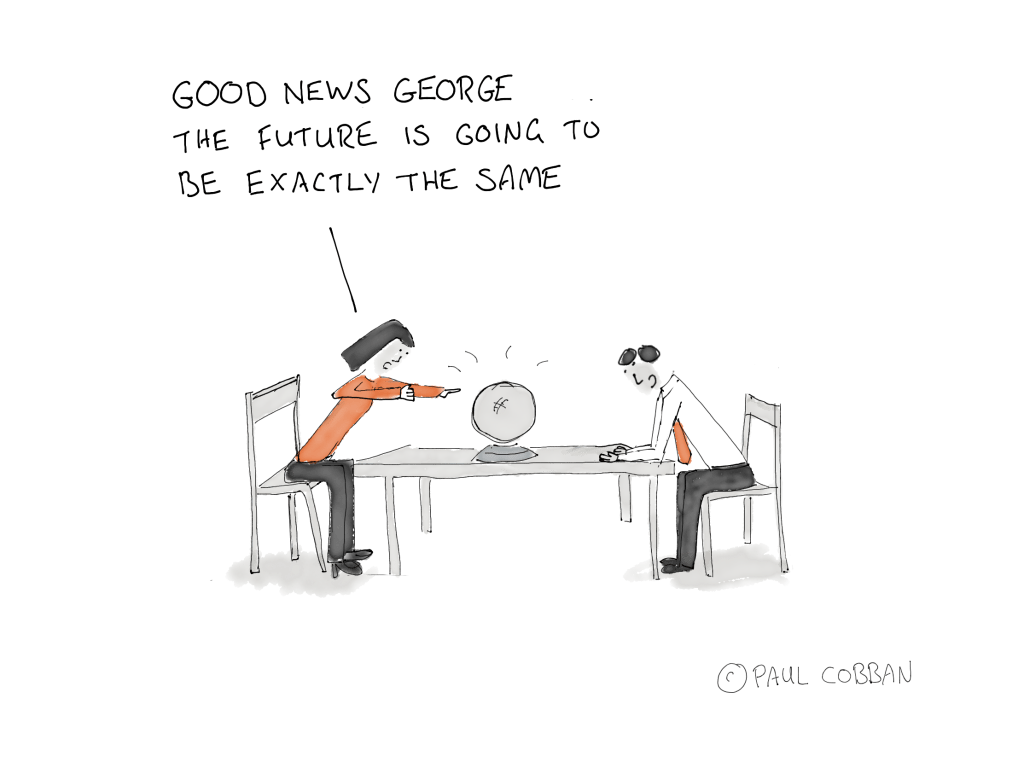
Companies that execute successful transformations seem to be able to predict the future better than others. They spot trends early and are able to make informed investment decisions that give them a head start developing innovative solutions. Do they employ psychics or have leaders with superpowers? Clearly not. It is because they follow a structured approach to understanding the future. 

There has been a lot said about agility and the need to sense and respond. Being able to quickly adapt to changes is an essential component of being prepared for the future. However not enough companies focus on improving the time it takes to sense trends.

Like everything in life to get better at something you need to put in the time. Reading articles on the plane (remember that?) isn’t going to be enough. Best in class leaders allocate significant amounts of time with their top teams getting inputs from world class thought leaders, deep subject matter experts as well as the views of their own people. Based on these inputs leading companies develop an informed view of what they collectively believe the future holds in 5, 10, sometimes even 100 years out.  With this in place informed investments can be made to best prepare for the predicted future.

It is important to remain focused on the emerging trends that are going to be relevant to the business. There is going to be hype and it is very easy to get sucked in. If you cannot see line of sight on how a new technology is going to help improve the lives of your customers or solve a business problems, park it for now and revisit. When blockchain first emerged it felt that all of the world’s problems were going be solved but to date only a tiny fraction of use cases ended up solving real problems.

While I was at DBS we spent 3 days every year with the CEO and top team focusing on the emerging trends, getting the views of the world experts, studying the best in class across all industries and asking our own people for their views. The majority of the time was spent debating the relevance of trends to the business and selection experiments to run to learn more.  

In addition each business area went through a back-casting exercise based on a board game we created called North Star where leadership teams visualised the future by prioritising a series of pre-canned technology, macro social-economic and industry statements (eg 80% of cars will be autonomous, average life span will be 110)  in terms of probability to be true in 10 years and relevance to their respective businesses. The teams then decided what areas should be invested in over the next 12 months to prepare for the predicted 10 year view. A proportion of the annual investment budget was then allocated to creating experiments to test feasibility and viability of the ideas. This resulted in a more ambitious innovation strategy.

However, there is one big danger out there – the HIPPO or Highest Paid Person’s Opinion.  No-one can completely predict the future. Those that do just are lucky. The leading innovative companies consistently estimate that one idea in 20 is a good idea. Therefore you have 95% chance of getting it wrong. Therefore you should expect to be wrong. However it is not uncommon for the entire workforce to pivot to something that the leader has said in passing in a meeting. Egos and ignorance can make it tough to change course. Therefore companies pursue what Scott Anthony would call “zombie projects” too long. Best in class companies build a culture where each idea is treated as imperfect and is tested and tuned through experimentation and data.

Leadership Lessons

Spend time as a leadership team getting inputs from all quarters to make an informed view of the future

Make sure that the focus remains on future trends that are most relevant to the business and customers and make the relevant investments now to best prepare for your predicted future.

Expect to be wrong.  No-one can accurately predict the future so you need to continually check that ego driven beliefs are not taking the company in the wrong direction.

If you enjoyed this post please add your email here and you will receive the next post directly to your inbox.