In The Hunger Games series the overlords keep rule over the people by conducting an annual battle to the death between adolescent representatives from each of the 12 districts of Panem. The Hunger Games are battles designed to lethally weed out the weak and reward the winner with eternal glory. The organisers manipulate the game so that any attempt to forge alliances is punished and blood-thirsty competition is encouraged. Does this environment bring out the best in people? It certainly focuses the mind on what it takes to survive but at the cost of everyone else. It seems that in the corporate world we have adopted a similar philosophy and baked it into our performance management systems.
I was in Africa recently helping a client with their people driven transformation. The subject of performance management came up. They told me that the culture in Africa is centred around relationships and African people are quick to become good friends with their colleagues. The adoption of western performance management techniques of force ranking to a bell curve, giving tough feedback and managing out the bottom performers is at odd to their values yet African companies face pressure into adopting such practices since this is what is taught in Business Schools and deemed to be best practice.
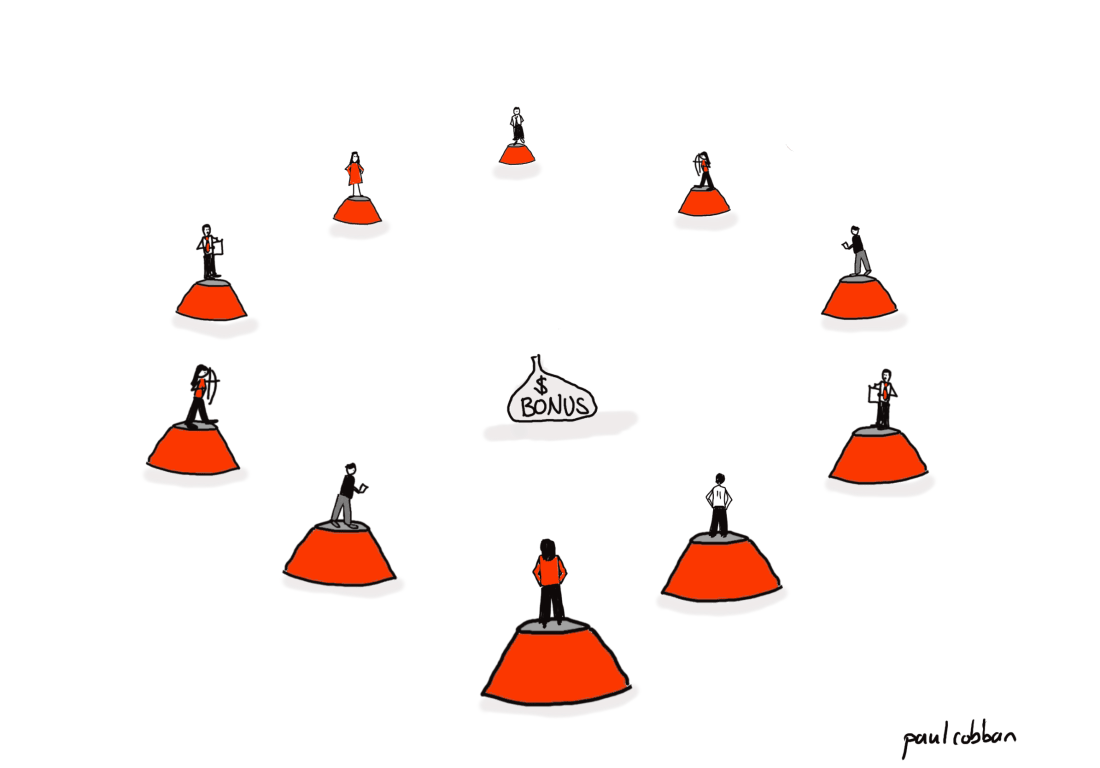
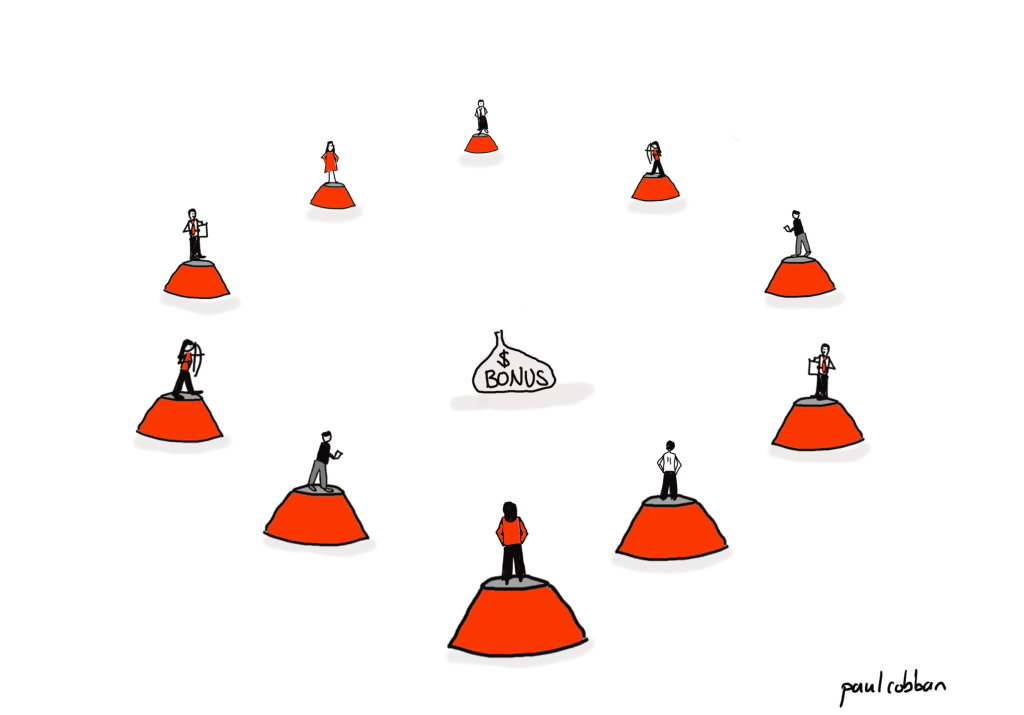
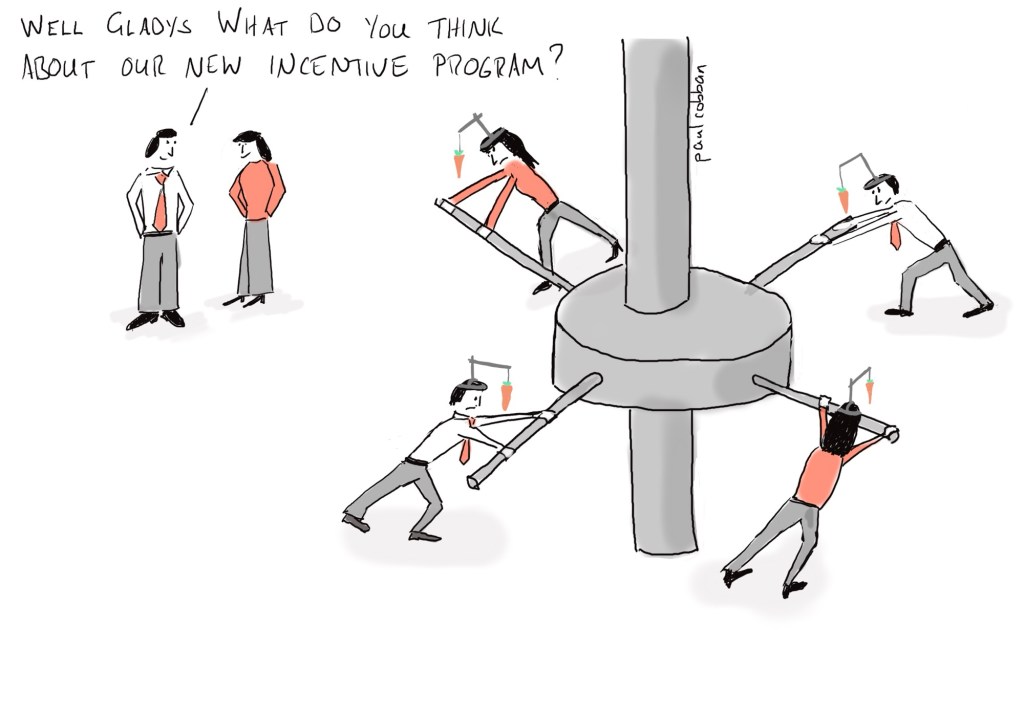
I am all for objective setting as it provides alignment and when used well gives a clear sense of priority. It allows employees to see how their work fits into the overall purpose of the company. However I do not see individual objective setting as an effective mechanism for driving performance. In fact I would argue that current practices are counter-productive. If an employee knows there is a finite number of ratings at each appraisal rating level and there is a fixed bonus pool that will be allocated out based on each rating then they are less not more likely to collaborate for success. Just like the participants in the Hunger Games someone else’s loss is their gain.
The highest performing teams are typically in sport or the military where teams win or lose collectively and there is far less emphasis on individual performance management. It is time for corporates to start to rethink how to get the best from their employees collectively. Leaders need to stop thinking like 19th Century industrialists assuming that workers will try and do as little as possible and start to create environments where everyone can do their best work.
And to my new friends in Africa I would suggest that you should stop trying to emulate Western practices and develop a performance management system that celebrates the African relationships that are at the heart of your culture and not destroy them. Then we can all learn from you.
If you enjoyed this post please do share with your friends and colleagues.
If you would like the my next post delivered to your mailbox please enter your email below
What is your reply when you get asked the cliched dinner party question “What do you do?”. Do you talk in general terms? “I am in finance” – worried that you will be judged. Or do you mention your job title? “I am senior vice president of [insert very important dept name]” hoping to impress. Although most of us hate the question the truth is that work defines us, it is part of our identity. Maybe there is a more thoughtful way of thinking about our jobs. Interestingly research tells us that people who are happier at work have a different response to the question.
People are happier when they define themselves not by industry or title but by how their work has a positive impact on others whether it be customers, fellow employees, suppliers, communities or even future generations. It is easier for employees to take this approach when they work for companies that also define themselves in terms of how they improve lives. Purpose is a strong motivator.
Yet most companies struggle to get it right. They understand that employee experience is important, not to help with progressing company purpose but because, as we were all taught at business school, happy employees make customers happy and happy customers make shareholders happy. Leaders tend to focus on the extrinsic motivators such as pay and perks. However these are table stakes.
As the late great Clayton Christensen points out in his book “How to Measure Your Life” being a leader is a noble profession and it comes with great responsibility. Just as leaders of construction companies need to ensure the physical safety of their workers by providing helmets and hi-viz jackets, leaders of all companies are responsible for the mental wellbeing of their people. If your people dread coming to work and have that sinking Sunday evening feeling you are shirking your responsibility.
Meaningful work is the most important factor in enhancing employee wellbeing. To unlock the passion of your people you need the power of purpose (eat that Peter Piper). I will be writing about what it takes in future posts so if you would like to receive my pearls of wisdom in your inbox enter your email here.
Since “retiring”, as well as helping companies transform, I have been taking full advantage of living in Scotland by regularly hiking in the beautiful Scottish Highlands. Compared to other mountain ranges the peaks of Scotland are not particularly high but they are demanding and in certain conditions dangerous. To ensure a safe return you need have the right clothing and equipment, experienced companions, a level of fitness and skills in navigation. You also should be able to read the weather and know when to turn back when conditions turn against you. To go out ill-prepared would be foolish. Yet week after week I read stories in the newspaper of inexperienced hikers setting off in tee shirts and flimsy footwear only to get into trouble and require rescuing or sadly, in some cases to suffer injury or worse.
Driving change is one of, if not the toughest jobs in corporate life. It requires a unique and broad set of skills which I have written about in previous posts. For a chance of success a transformation leader requires an understanding of tools and frameworks, an ability to navigate corporate politics, an ability to influence, an ability to incite a movement in a company and skills in reading and adapting to the environment both internally and externally. However typically a “high potential” talented leader is tapped on the shoulder and asked to scale “Transformation Mountain” in perilous conditions without training, equipment or experienced companions. In corporate life there is no mountain rescue team and many transformation leaders are left to perish on the slopes.
This is so easily remedied. Like mountaineering, given the right equipment, training and an experienced guide, all the most common pitfalls can be avoided. I have found myself being a “mountain guide” for a handful of ambitious but thoughtful companies over the past 18 months. Companies that have had the foresight to realise the dangers of the transformation journey and want their team to arrive at the top in one piece and enjoy the view.
This is the first of the two ways companies tend to set up their transformation leads for failure. Any thoughts on the second? This will be the subject of my next post. If you would like it to hit your inbox please subscribe here.
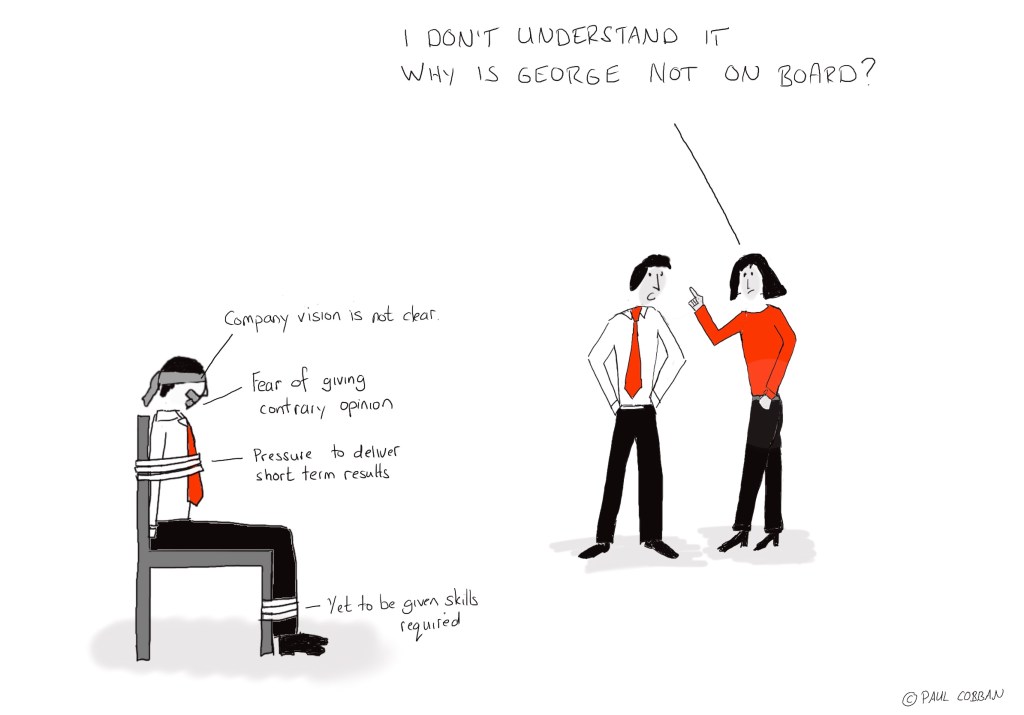
The most common complaint from leaders of transformation is that one of their key stakeholders “simply does not get it” – “it” being the need for change or the understanding of the approach. How can this be? Surely the need for change is clear, the concept is not hard to understand. The implication of such a complaint is that the fault lies with the stakeholder. This, of course is invariably not the case.
The vast majority of people come to work eager to make a positive difference. However, companies have evolved to put barriers in the way of enthusiasm. If there were no barriers the required change would have happened already. The job of the transformation leader is to remove the barriers thereby releasing the passion of the people in the company. If people appear to hesitate, barriers remain and the transformation leader has more work to do. You can follow 3 steps to ensure everyone in your company gets on board your transformation program.
Expect resistance
People will resist change while there are barriers in place. If you do not witness any resistance then you are not looking hard enough or are not really changing anything.
When Rock and Roll emerged in the 1950s it was seen by some as “the music of the devil”, when Bob Dylan changed from acoustic to electric guitar his fans called him a traitor and when Stravinsky premiered the controversial “Rite of Spring” in 1913 there were riots in the streets of Paris. Change will always cause a reaction therefore don’t be surprised by it. When resistance emerges you should celebrate because it will give you the opportunity to address it head on.
Identify the barriers
Resistance is due to real or perceived barriers. You can only deal with the barriers if you know what they are. Some people will voice objections to change and some will not. Those that do will often cover their real concerns with a facade of fabricated issues. Getting to the real causes of resistance can therefore be tricky. I have found the best approach is to actively listen to people who are demonstrating resistance thereby building empathy for their concerns. By listening and playing back their point of view you are likely to gain an understanding and also break down the first barrier – the feeling of not being heard and understood.
Many concerns usually are underpinned by fear. Fear of losing power, fear of presenting a contrary view, fear of being punished for not meeting next quarter’s numbers, fear that I will be criticised by my immediate supervisor who is also resisting. When fear is the driver, the stakeholder may not be as forthcoming with the real reason. In this case it might be better to speak to the people who know the stakeholder best to get a deep understanding.
Deal with the barriers
How to address each issue will be determined by the nature of the issue. The good news is that most fall into common patterns. I have listed some of the techniques that we have developed to address the most common themes.
Ensure that the end state is perceived to be vivid and compelling.
People are only going to agree to come on the journey with you if they understand the destination and it aligns with their beliefs.
10x your communication
Transformation leaders (including myself) tend to vastly under-estimate the communication required to secure understanding and buy-in. Take the effort you think you require to communicate then multiply it by 10. You should continually test for understanding and buy-in and refine your communications accordingly.
Co-create the program with as wide an audience as possible.
There is no better way to create buy-in than making it everyone’s idea. This is best done by working with the extended top team to create the vision and high level approach and then getting input from across the company. The best programs allow each area to contextualise the vision and approach to be relevant for their own areas.
Showcase the early supporters of the program.
People will be more willing to get on board if they see people they respect leading the way. Therefore make sure early support is highly visible across the company. Make videos, share interviews and publish stories that showcase people who are onboard.
Use cognitive dissonance for the detractors.
By getting those less supportive to publicly show support for the program makes it very difficult for them to resist in private. You can ask seniors in the company to participate in townhalls where there is an expectation for them to show public support.
Ask to perform experiments where people are cynical.
If you encounter stakeholders who have deep cynicism about the approach, you can ask permission to run an experiment to determine the outcome. This is a less threatening approach as there is no obligation to commit until the results of the experiment are known.
Use governance to show sponsorship and align people.
Like most people I am not a great lover of meetings. I have spent a good portion of my career trying to figure out how to reduce the number and duration of meetings in my life. However there is one exception. When designing the governance around transformation programs I encourage longer, larger meetings. The reason for this is to show as many people as possible the sponsorship from the top and the progress being made. It does no harm to allow some healthy competition amongst departments by comparing progress league tables.
Expose the root causes of fear.
If fear is being created by a common theme, you can also use governance meetings to expose it in a safe way. You can include a specific agenda item to cover barriers and blockers. An update might be “ We have received feedback that many people are concerned that they are going to lose status as a result of the change”. By keeping it anonymous you provide safety whilst exposing the root cause.
Give up the credit (this is the tough one).
If you work for an organisation where end of year appraisals and performance assessments have an impact on pay, there is likely to be an informal system of “credit” in place. People will move to demonstrate that they deserve their share of “credit” for the good things that happen in the company. Come the end of the year they “cash in” their “credit” for a pay rise or bonus. As a leader of transformation you must give up your credit to others. You should avoid at all costs claiming that progress is down to your leadership, support and influence. If people see that credit is coming their way due to the transformation program they are more likely to get on board. I have found that the majority of people will give back some credit saying that they could not have done achieved what they did without the transformation team. I have also benefited from the fact that my own bosses were insightful enough to recognise my team’s contribution.
Influencing at all levels is the fifth essential habit of leading transformation. In previous blogs I have covered “Insistence on improvement”, “Intellectual Humility”, “Impatient Learning” and “Inciting a Movement”. There is one more to go in the series and if you would like it and any other posts sent to your inbox as soon as I publish it please enter your email address below.
Do leave a comment if you have other methods that help influence others to join the journey.
Why is it that the vast majority of corporate transformations do not achieve their stated ambitions? Why are people in companies so cynical about change programs? Why are employees so keen on keeping things the same even when it is clear that the very survival of their company depends on changing.
Success or failure depends on your transformation philosophy. Depending on your philosophy you are likely to choose 1 of 2 ways to design a transformation. One approach, let’s call it type 1, is almost guaranteed to fail or at best deliver short term diluted results. The other approach, type 2, when successfully designed and executed will not only exceed any stated business outcomes but create a motivated, purpose driven movement within the organisation that can learn and adapt, drive future improvements, attract the world’s best talent and ultimately make the world a better place.
However most companies choose a type 1 approach as it is what is taught in business schools, recommended by consultants and expected by boards, shareholders and investors. Organisations that take this approach are destined for a long uphill battle often littered with face saving manufactured results. Employees are perceived to resist change and be “the issue”. Whereas the true resistance lies in the mindset of the leaders. The lack of intellectual humility in ego-driven leaders means that new approaches are shunned and the old type 1 approaches remain in place.
For a leader to embrace a type 2 approach requires intellectual humility, a passion for learning but most of all faith and trust in people. A belief that people always aim to do the right thing, they will be motivated by meaningful work and that the role of the leader is simply to create the conditions so that change can happen.
So what are type 1 and type 2 transformations?
Well type 1 transformations are those that treat a company as a machine and apply industrial-age management techniques to bulldoze the company into change. Business cases are written, consultants are hired not just to advise but to actually do the work, the transformation is set up as a project with a beginning and an end. People who are seen to get in the way are fired, the remainder have KPIs linked to financial reward to incentivise them to achieve results. Those results are defined in purely financial terms. There is tight governance where leaders micro manage, make top down decisions and ultimately create a culture of fear.
Leaders of type 2 transformations on the other hand consider their company as being made up of people. People with passion, skill and experience, that if unlocked can move mountains. Leaders of type 2 transformations realise that nothing changes unless the behaviour of the people changes. Type 1 leaders will focus on changing a technology or process, type 2 leaders will focus on equipping, empowering and enabling people so that they will be motivated to improve processes and technology themselves. Type 2 leaders recognise that companies exist not to make their shareholders richer, but to improve the lives of their customers, their employees, the members of the communities in which they operate and future generations. Having strong financials is of course essential to keep a company in business but it is not the primary outcome.
At DBS we ran a type 2 transformation. The transformation was named as one of the top ten transformations of the decade by Harvard Business Review alongside companies such as Microsoft, Netflix and Amazon. It took DBS from being an underperforming bank known for its poor customer service to being the first bank in history to be named as the Best Bank in the World by all three of the top financial periodicals. Many cases studies and articles have been written about DBS but none that I have seen have highlighted that simple fact that it was type 2 thinking that led to this success. While I was at DBS many companies came to see us to learn from our success. Since retiring from corporate life I have been advising companies. And I have seen that most companies are set up to drive change with type 1 thinking and are thereby destined for disappointment.
This is unsurprising. I used to by a type 1 thinker. It was what I was taught. It seemed to work for short term projects. It was almost by chance that we stumbled into a type 2 approach at DBS. But it was when we started to implement type 2 principles that we created a movement within the company and the magic started to happen. So if you are lead change in your company it may be worth while thinking which approach you are taking.
The “focus on inciting a movement” is the 5th habit required of leaders that are driving transformation. I have covered the others in previous posts.
I will be covering the fifth essential habit for leaders of transformation in my next post. If you would like to it to appear in your inbox as soon as I post, please leave your email below.
If you are interested in learning about my masterclasses and coaching click here
What happens to our curiosity as we grow up? As soon as we are born we are asking questions of the world. Before we can talk we are looking at, touching and (in the case of my children) tasting everything around us. The moment we can string a question together we ask incessant mostly unanswerable questions to our irritated parents. But then we go to school and something happens. We are rewarded for answering questions from an ever-decreasing corpus. No credit is given for asking great questions. By the time we enter the work-place, all curiosity has been beaten out of us. We enter a world of work where everyone seems to be an expert and asking questions becomes an act of personal courage rather than driven from a sense of wonder. Yet curiosity is what drives innovation. Challenging questions provoke better decisions. We all have innate curiosity yet the companies that employ us are suppressing it rather than utilising its boundless power.
The problem is partially created by the corporate structures that have evolved over decades. For example consider how funds are allocated for business initiatives. An idea is promoted by a business leader who will pull together a business case which at best is a guess based on a set of unspoken assumptions but is often an overly spun work of fiction. We then assign accountability to the business leader to deliver the business case. Her bonus will depend on the outcome and therefore she will spend all her energy demonstrating that the original idea remains a good one despite any emerging contradictory evidence. There is strong pressure to avoid the challenging questions and curiosity is suppressed.
Therefore companies find it hard to stop investments that are not working. Riskier bets are avoided as it means someone has to stake their career on the outcome.
A large part of the key to unlocking curiosity therefore is to re-invent the structures that suppress it. For example here are three elements of an alternate approach that replaces the career threatening business case with a curiosity driven approach.
When considering how to improve an aspect of business performance, define the desired outcome very precisely. Identify the exact measure that you will use to measure attainment of the goal. This can be financial e.g. revenue from new customers over the next 3 months or a customer goal e.g. improvement in the App Store rating over the next 10,000 downloads. Then specify the 3 to 5 drivers that you believe have most impact over the outcome and you can influence. For example salesperson training or the response time of the app. Ensure that outcomes and drivers can be baselined and measured. What you have is a simple model of your business and your strategy. Interestingly, the choice of drivers and outcomes is often at odds with a previous stated strategy.
Build an understanding of the causation between the drivers and the outcomes by running a series of experiments. As opposed to pinning all hopes and reputations on untested assumptions, set out to learn what are the most impactful drivers. List out the hypothesis, construct the experiments and look at the results. There should be as much celebration if the hypothesis is proven to be incorrect as if it is correct since you will have avoided wasted effort. Through experimentation you can learn whether you have the right drivers and become increasingly granular in your understanding of the relationship between driver and outcome. This approach is of course based on the scientific method which has been the basis of scientific learning, but shunned by the vast majority of businesses, for centuries.
Change the way business reviews are conducted. Other than help remove obstacles, senior managers reviewing such an approach to improving business performance should focus on 2 questions during a business review
What do you expect to learn from the experiments that you are running next week?
What did you learn from the experiments you ran last week?
This approach forces a conversation based on curiosity and soon the focus of the team will pivot to question how to increase the rate of experimentation so that the learning can be faster. They will have developed the habit of “impatient curiosity” which is one of the six essential habits of transformational leadership.
Following this approach means that accountability for outcome remains but is not fixed to a set of assumptions that cannot be adjusted.
One of the hardest things for leaders to do as they find success in their careers is knowing when to shut up. The more senior a leader becomes, the more the people in their organisation scrutinise their every word and action. Suggestions become commands that quickly cascade throughout the company. A view stated too early in a conversation will close down any contrary views reducing the quality of decisions and ideas. Well intentioned leaders wanting to add improvements to ideas presented to them can destroy the commitment of the person delivering the idea by appearing to make the suggestion their own.
In their defence leaders are expected, by all around them (including themselves) to be the expert in the room. The Highest Paid Person’s Opinion or HIPPO tends to win the day. In our fast changing, complex world where no one person can be the expert in anything, this is increasingly a problem. Mental models that have served us well are no longer relevant. Leaders need to ensure they take advantage of the collective intelligence in the room and fill missing information with data and experimentation. The first step is to listen to others and seek out data before speaking out.
In his book Rebel Ideas, Matthew Syed talked about the value of having diverse teams so that more is known about problems before deciding on a course of action. The more diverse the team the more diverse the opinions and thought processes are and the better the decision making. However to allow this diverse collective intelligence to operate, there needs to be an environment where people feel they can air a contrary view without fear of negative consequence. It is a leader’s role to create such a climate. For many leaders this does not come naturally. Some I speak to who have, shall we say, an “assertive manner” tell me that people need to “just grow a backbone” or “get thicker skin”. This is obviously an attempt to put the blame for the problem that they have created on others. Leaders should go into decision making processes with intellectual humility and genuine curiosity. Curiosity is the antidote to fear. As a guide there are 3 steps that leaders should take when embarking on a decision making journey.
Assess the dimensions of the problem. Problems and decisions come in all sorts of shapes and sizes. Some require urgent action where there is no time for discussion. Some have critical implications where delegation is not appropriate but a good proportion are suitable for discussion and are an opportunity for everyone to learn.
Ensure the knowledge in the room is aired. All too often a leader (Boss Bob in the picture above) does not extract the collective intelligence in the room. Not only does Bob think that he understands pretty much everything about the issue in hand, he airs his opinion too early closes down others who have have alternate views and suggestions on how to improve the decision. It is often the quietest person in the room (Introverted Irene) who has the most valuable thing to add but is drowned out by the loudest (Loud Larry) who has an inflated view of their expertise. Like all companies, at DBS we had our share of Bobs, Larrys and Irenes. So we introduced a meeting ritual called Wreckoon. Wreckoon was an idea borrowed from the software developers at Netflix. In order to encourage their developers to write stable code, they introduced software into their data centres to deliberately cause problems, for example intentionly shutting down a server. Netflix named this software chaos monkeys and formed a new discipline called chaos engineering. At DBS our developers did something similar in our data centres but named the software Wreckoon. In order to improve our decision making processes, we had the idea of applying chaos engineering to our meetings to ensure we were maximising collective intelligence and encouraging alternate viewpoints that would be the equivalent of shutting down a server. We mandated that in meetings, there needed to be a “Wreckoon” slide inserted at the most critical point in the associated slide deck. This slide apart from having a cartoon image of Wreckoon would ask questions such as: What have we missed? What is the contrary view? When the slide was shown, the chair of the meeting encouraged everyone to answer the questions especially those that had not yet spoken. The results were very positive. In my experience, 90% of the time when we used Wreckoon we got valuable information from the group that we would have not otherwise. More importantly, Wreckoon became part of the vocabulary. People would say “I am going to be a Wreckoon here”. This was a signal that someone was going to air a contrary view but with the safety of knowing that the behaviour was to be encouraged.
Extract the knowledge that does not exist in the room. Not everything can be known before a decision is made but there should be explicit consideration for what is not known and whether there is data or experiments that can fill the gap in the timeframe. The leader’s role is to encourage the team to experiment and analyse any data. The leader needs to ensure that he/she does blindly overrule the data based on their own potentially outdated mental models. This behaviour is the subject of my next post.
“Intellectual Humility” is the second of the 6 habits required to lead transformation. My last post covered the first – “Insistence on Improvement”.
If you enjoyed this post and have the “genuine curiosity” to read about the next habit, please leave your email here and my next post will appear in your inbox.
Companies are designed for inertia. They are made up from standard processes to drive productivity and policies to ensure people do not cross lines. We hire people who are like us and place them in an organisational structures where they sit with people with the same skills. We set higher performance targets each year but the default mechanism to achieving them is to work harder rather than change the way we work. To drive improvement in this environment is to push against the very fabric of the organisation and any brute force attempt to do so is destined for failure. Only by systematically addressing each of these components will a climate for change emerge where people can embrace change and sustained transformation becomes possible. In parallel, leaders need to be the enemy of the status quo and create the expectation that improvement across the company is the norm. There are 3 essential areas for leaders to focus on.
Create the expectation to improve
Over a decade ago, when I was studying lean principles, I travelled to Japan on a study trip to tour to and learn from respected manufacturing plants. I was guided round one of the factories by a sensei (quality guru). At one of the stations he stopped, glanced at some documentation displayed and proceeded to scream at the section supervisor in Japanese. Once he had finished he explained to me very calmly that the supervisor had not updated his standard work for 6 weeks meaning that he had not found any improvements on how the job should get done. He added that the role of leaders is to solve problems and drive improvement. Otherwise why did we need leaders? He expected that each supervisor should update their standard work at least weekly. Whilst I did not support his fear-inducing leadership style, his drive of continuous improvement was a light bulb moment for me. The sensei had created an expectation for improvement. He went on to tell me that the 2 most important questions for a leader to ask were firstly “How are you performing to standard?” in other words: given the current resources and processes are you hitting the expected levels of productivity, quality etc. And secondly “What experiments have you run to move to your target state?” You will only be able to improve if you change the way you work – it is not about working harder and this is best achieved through experimentation.
These two questions may seem very operational in nature but they can and should be adapted to all parts of an organisation. People across the company should be rewarded for improving how the job is done not just performing the job.
Create the bandwidth to change and then move to BAU
Back in 2009, shortly after I joined DBS my team ran a programme aimed at taking customer waiting time out of our processes. DBS was known as Damn Bloody Slow since we were famous for long queues at our branches, ATMs and call centres. My team set up a program of process improvement events (PIEs) which were week-long workshops attended by employees who between them knew the target end-to-end process. They physically walked the process identifying issues and then back in the room ideated improvement ideas and implemented as many as possible in the week. In the first year we ran close to 50 PIEs and we dramatically reduced the customer waiting times, taking an estimated 250 million waiting hours out of our processes. We went from the bottom to the top of the customer satisfaction scores in 12 months. The PIE program could only have happened had there been a dedicated transformation team driving it from the centre. The team designed the approach, scheduled the workshops, provided the training, facilitated the sessions and reported on the progress to the CEO. We were highly successful for a couple of years but as focus moved onto the next transformation and since the people participating in the PIEs had day jobs, the focus began to wane. The improvement workshops were seen as one-off exercises. The expectation for improvement was episodic and not continuous.
We realised that we had to embed the need for improvement into BAU. We pivoted the program after a couple of years to replace the workshops with DMS (DBS Management System). Business reviews were no longer conducted in meeting rooms but on the operations floor at visual management boards. Leaders asked a version of the 2 questions from the Japanese sensei – “What are the issues that are preventing you performing to standard levels of quality, productivity and risk?” and “What experiments are you planning to get to the target improved state?”
With this approach the onus was on the leader to walk the floor, to ask the right questions and create the expectation that driving improvement was part of the day job, not a one-off project.
Create a safe environment to challenge
There are points where even the most empowered team feel that they have hit a brick wall. This typically happens when they run into an ingrained corporate habit or out of date policy? Common comments include “We cannot change, it is against the policy” or “our compliance team will never agree”. For people to be able to overcome such situations, it is important to put in place mechanisms to allow anything to be challenged safely. In the PIE program we ensured that there was a compliance person in the PIE team to address concerns early and be part of the solution. Later we set up a Kiasu committee (Kiasu is a Singapore dialect term meaning fear of missing out or to be overly conservative). Anyone could bring a policy to a Kiasu Committee to be reviewed. The committee was chaired by the Compliance head (who dressed up a like a judge and had an over-sized gavel) and made up of a “jury” comprising senior and junior employees who deliberated whether the policy was “guilty” of being Kiasu. If found guilty the process would be amended. The environment was fun and good-natured. In the first year, around 100 policies were challenged with over half being found “guilty” and amended. Quite often the owners of the policies that were deemed to be “not Kiasu” felt that they could improve and amended their policies anyway.
“Insistence on Improvement” is the first of the 6 essential habits of leading transformation. I will be covering the other 5 in coming weeks.
If you enjoyed this article please do leave your email here and my next post will hit your inbox.
When the pandemic first hit most of us were surprised at the effectiveness of distributed virtual workforces. We also learnt how relentless Zoom calls and lack of demarcation between work and home can lead to burnout and other mental health issues. However, as we gradually emerge from COVID 19 it seems that most office-based companies intend to reap benefits of reduced real estate cost and employee flexibility by adopting some version of hybrid working. Whilst such a move has clear upsides, there is a ticking time bomb that is not receiving enough consideration. Unless we have a radical rethink on how to protect corporate culture it will whither to the point companies will be destroyed. The impact will affect the very nature of work for future generations. What can leaders do now to halt the decline?
Back in February 2020, a son of a friend of mine was excited to join a financial services company straight from college as a software developer. The company was located downtown of a vibrant city and he was looking forward to both learning new skills and forging new relationships in the office, over lunches and drinks after work. Five weeks later and before he was able to make any meaningful relationships he, like many others, was working from home. Meetings switched immediately to Microsoft Teams and were largely camera-off affairs. When he needed help, rather than chat to the person sitting beside him he was told to schedule a meeting. As the pandemic eased, as soon as he was allowed to do so, he returned to the office but he discovered that he was alone – his colleagues preferred to continue to work from home. After two and a half years he still has not an inkling about the company culture, has become disengaged and is now looking for a new job.
Because of COVID, employees of companies worldwide have experienced the flexibility of working from home and the elimination of painful and expensive commutes and are now choosing to work from home and are prepared to move to companies that allow them to do so. They are prioritising convenience and flexibility over comradeship and culture. This is not only impacting the minority who are looking for an office-based experience (especially those new to the company) but is putting entire companies at risk over the long term. It is hard to see how corporate culture is going to survive. Given weaker culture, less and less people are going to engage with the companies and work will become increasingly transactional.
Interestingly most of us did not feel the way about our families as we emerged from the pandemic. We did not decide to move to a hybrid model for hanging out with our friends. We have returned to the traditional model of hanging out face to face. In this case we have prioritised camaraderie and relationships over “flexibility”. What does this tell us about what we really think about work?
Leaders, especially those driving transformation need to focus more than ever on building culture. When your team is physically in the same location it makes it far easier to drive engagement and culture. Observing the informal rituals, having conversations in the corridor, even seeing how people are dressed inform people of the culture. Leaders of transformation have more opportunities to impact the culture when people are in the office. For example the characteristics of the physical office space drive behaviour more than most give credit for. At one point in my career in addition to my role as Chief Transformation Officer, I oversaw the real estate and facilities for DBS. It was during that time I discovered how powerful physical space can be as a driver of positive change. People tend to behave based on the physical environment around them – you behave differently in a library and a supermarket.
Left untended desired culture will decay over time. When people are not physically together the culture half life reduces dramatically. As people leave and new people join the culture will be lost and engagement will drop. As people feel less engaged they will look for higher pay and flexibility elsewhere. Companies will not be able to attract talent. There will be no engaged army for future transformation. Companies will erode and ultimately whither.
Leaders need to act now. They should understand the drivers of decay. Some of the factors are as follows.
Starting health of culture
Attrition rate
How much effort leadership puts into maintaining and developing culture. Taking a culture by design approach is key. Scott Anthony and I wrote about this in HBR.org and the approach is detailed in our book.
Leaders have 3 choices.
Do nothing. Believe corporate culture is a thing of the past and accept that work will be increasingly transactional.
Insist people come into the office and work on the employee experience so that more employees will prioritise camaraderie and culture over flexibility and reduce the risk of people looking to other companies that provide flexibility and offer higher pay.
Continue with hybrid working and work ten times harder on developing culture using a “culture by design” approach.
If you enjoyed this post please subscribe below and my next will be sent direct to your inbox.
Why is it that everyone sagely agrees with Peter Drucker’s aphorism that culture eats strategy for breakfast but the vast majority of companies spend far more time on their strategy than their culture? We organise strategy offsites, strategy departments are set up, extensive strategy documentation is developed, expensive strategy consultants are engaged and we present strategies for endorsement to our boards. Yet for most companies any focus on culture is simply well-meaning lip service or a part-time hobby for an overstretched HR department. Is this because defining and progressing towards a target state culture is hard? Is it because demonstrating that culture yields direct business benefits is not possible? Is it because we do not really believe Peter Drucker?
As I wrote in the first post in this blog the single biggest insight of my career to date is that transformation is about people. Processes and technology do not change themselves. People drive change and to drive transformation at scale you need to create any army of engaged and motived people. There are many stats quoted (mainly in the presentations from those highly paid strategy consultants) on the low percentages of successful transformation programs. These failures are often due to the lack of focus on culture, not the application of the wrong strategy.
More and more strategies are centred around digital transformation. Successful digital transformation is not about the blind implementation of new technologies but the mindset of continuously improving customer solutions by the application of suitable technology. True digital leaders are impatiently curious about what works and what does not. This is a culture issue not a strategy issue – digital culture eats digital strategy for breakfast, lunch and dinner. Strategy, digital or otherwise is important in setting direction but sustained execution depends on behaviours. Yet pretty well everyone I speak to agrees that in their companies there is much more focus on digital strategy and little or no attention to the behaviours. Part of the reason is because how to develop corporate culture is not taught in business schools, it is not role modeled by leaders – it is new for most people. The good news is that more and more companies are believing in the importance of developing a digital culture although are not sure exactly how to go about it. The even better news is that it is not difficult if you are prepared to focus on it. Here is the high level approach.
Be explicit about your desired culture. Corporate culture is the sum of the behaviours of the people in the company. You should define the desired behaviours that are going to enable the purpose and accelerate the strategy of the company. This helps to address the link between culture and business outcomes. At DBS we set out to be a 27,000 person startup as we wished to operate at speed and at scale. Clearly we were not a startup, we were a fifty year old bank but we precisely defined the behaviours of a startup that we wished to emulate.
Build a dedicated program to develop the future state culture based on the “culture by design” approach that we pioneered at DBS and set out in the book Eat Sleep Innovate that I co-authored with Scott Anthony, Natalie Painchaud and Andy Parker. I shall be writing more about this in future posts so you do not need to buy the book to learn more but essentially you will need to address culture blockers through the conscious introduction of rituals, vocabulary and enablers.
Measure progress. The future state culture must be defined in terms of observable behaviours so that progress can be measured and issues identified.
The corollary of the afore-mentioned “one big insight” that transformation is about the people is that corporate culture is an important asset of the company. The leadership of a company are the custodians of this asset. The board should ensure that culture is nutured and developed by the leadership. There should be culture offsites and teams dedicated to defining and developing the culture. Progress should be reported in annual reports
And of course if you need a highly paid culture consultant you know how to reach me!!!
Leadership Lessons
Spend as much time (if not more) on culture as you do on strategy. Culture improvement is your most powerful execution enabler!
Be explicit on the behaviours that are required to deliver on your strategy. This is your future state culture.
Implement a program to develop the future state culture.
If you enjoyed this post please enter your email below to get future posts delivered directly to your inbox.









 Paul Cobban