We do not have a plan, thankfully

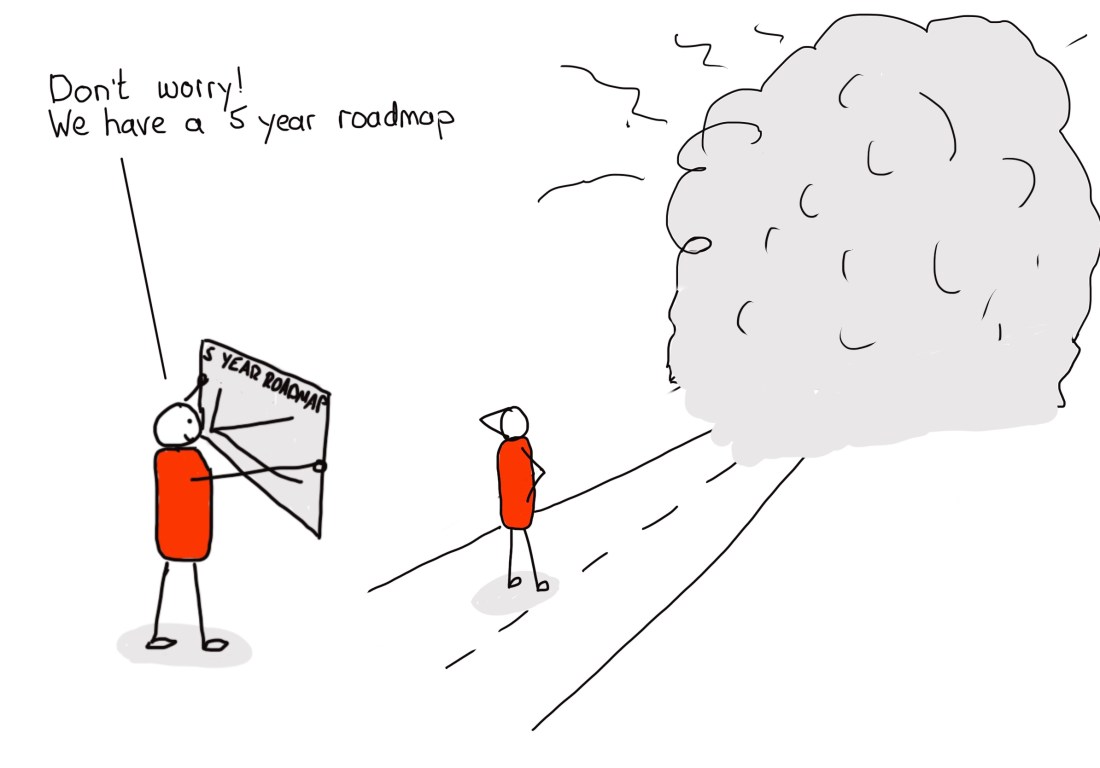
A cartoon depicting two stick figures on a road. One figure holds a sign stating '5 Year Roadmap' while the other looks concerned at a large cloud or obstacle on the horizon, with a speech bubble saying, 'Don't worry! We have a 5 year roadmap.'

A former colleague recently made me aware of a Harvard Business Review article in the latest issue.

It is called Transformation Should Be a Learning Journey, written by Evgeny Kaganer and Christoph Loch. The article compares the transformations of DBS and GE and argues that one of the reasons DBS succeeded was because at DBS, we treated transformation as an evolving journey of learning rather than a large project with a predetermined destination and detailed roadmap.

I had two reactions.

The first was that it is always slightly strange reading an academic analysis of something you actually lived through.

The second was: Yes. That is exactly what happened.

Although I am not sure we were clever enough to realise it at the time.

We certainly didn’t have a 13-year transformation plan

I joined DBS in 2009 to lead transformation. At the time the bank was famous in Singapore for being slow, bureaucratic and difficult to deal with. So much so that the initials DBS were jokingly said to stand for “Damn Bloody Slow”.

If you had asked me then to show you the master plan that would eventually take DBS from Damn Bloody Slow to being recognised as the Best Bank in the World, I would have had a problem.

There wasn’t one.

We knew we needed to get better. We had a new CEO, Piyush Gupta, with a strong sense of where the bank needed to go. But we most certainly didn’t know all the steps required to get there.

So we started with the problems immediately in front of us.

Customers were waiting too long.

We learnt from Toyota and introduced process improvement techniques across the bank. We called the programme RED – Respectful, Easy to Deal With and Dependable.

Hundreds of employees became involved. Customer waiting time fell dramatically. Customer satisfaction improved.

And, more importantly, we learnt.

We discovered that fixing internal processes was not enough. Customers didn’t experience our organisation as a series of processes. They experienced journeys.

So we started working on customer journeys.

That taught us something else.

The biggest opportunities to transform those journeys increasingly depended on digital technology. Which led us deeper into digital transformation.

That in turn exposed the importance of APIs, agile working, experimentation, ecosystems and eventually data and AI.

One thing led to another.

Looking backwards, it can look like an elegantly designed transformation strategy.

Living through it felt considerably messier.

And that, I now realise, was one of its strengths.

Direction is more important than a detailed destination

The HBR article makes an important distinction.

Transformations need a compelling vision, but leaders should not pretend that they know precisely what the organisation will look like several years into the future. In a complex and rapidly changing environment that is simply not possible.

Instead, transformation should progressively reveal the destination.

That fits very closely with something I have written about repeatedly since leaving DBS.

In my post The One Big Insight, I argued that:

Companies do not change unless the behaviour of their people changes.

Technology doesn’t transform a company. PowerPoint certainly doesn’t. Nor does a beautifully constructed transformation roadmap.

People do.

The role of leadership is therefore not to design every step of the journey and then persuade thousands of reluctant employees to follow it.

It is to create an environment in which people can move in a common direction, experiment, learn and change their behaviour as they discover better ways of doing things.

That sounds like a subtle distinction.

It isn’t.

It represents a completely different philosophy of transformation.

Type 1 versus Type 2 transformation

I wrote about this in Inciting a Movement.

I described two fundamentally different approaches to transformation.

Type 1 transformations treat the organisation rather like a machine.

Define the target state. Create the business case. Hire consultants. Break the programme into workstreams. Create milestones. Assign KPIs. Track the red, amber and green boxes. Escalate the people who aren’t complying.

The underlying assumption is that senior management knows both where the organisation needs to go and how it should get there.

Type 2 transformations start with a very different assumption.

An organisation is a community of people with knowledge, enthusiasm, experience and ideas. Leadership provides purpose and direction but creates the conditions in which those people can work out much of the route themselves.

The HBR comparison of GE and DBS provides an interesting illustration of the difference. GE’s transformation was much more dependent on a top-down view of where the company needed to go. DBS allowed knowledge generated throughout the organisation to change the direction of the transformation.

That distinction matters enormously.

Because the people closest to the work frequently know things that the executive committee doesn’t.

The transformation roadmap should be flexible

This doesn’t mean transformation should be some sort of corporate free-for-all.

Quite the opposite.

DBS had considerable discipline.

We had a clear vision. We had governance. We measured progress. We deliberately built capabilities. We had a transformation team. We invested significant leadership time.

But we didn’t confuse discipline with certainty.

This is something I explored in my post Being Data Driven.

One of the behaviours we eventually tried to embed at DBS was experimentation.

Instead of leaders always providing answers, we encouraged them to ask questions:

What experiments are you running?

What did you learn from the experiments you ran previously?

The subtle shift is from managing execution against assumptions to managing the rate of learning.

If an experiment proves your hypothesis wrong, that isn’t necessarily failure.

You have learnt something before spending millions of dollars discovering it the hard way.

Unfortunately, many corporate transformation governance systems do exactly the opposite. They punish deviations from the business case and therefore encourage people to conceal evidence that the assumptions behind the business case may have been wrong.

The transformation plan gradually becomes more detached from reality while everyone continues reporting that it is broadly on track.

Build capability before demanding results

Another aspect of the HBR article particularly resonated with me.

Kaganer and Loch describe some transformation investments as “options” – investments that build capabilities the company may need in the future even though there may not yet be a conventional financial business case for them.

That describes much of what we did at DBS.

We taught people customer journey thinking.

We taught experimentation.

We developed agile capabilities.

We developed data skills.

We built APIs before we knew all the things we would eventually do with them.

These investments didn’t always produce an immediate financial return. They gave us the ability to do things we couldn’t previously do. Those capabilities subsequently created options for the next stage of transformation.

This also connects to another of my earlier posts, The Essential Ingredient for a Successful Transformation.

Transformation requires capacity as well as intent.

At DBS we built a relatively small central transformation team. Our job wasn’t to transform the bank on behalf of everyone else. It was to build the methodologies, capabilities and confidence that allowed the bank to transform itself.

The HBR article describes that team rather nicely as an enabler and catalyst rather than the engine of transformation.

I like that description.

People don’t resist change. Companies do.

Perhaps the biggest connection for me is with something I wrote in The Fight Against Corporate Inertia:

People do not resist change. Companies do.

Companies have processes, policies, incentives, organisational structures, budgeting systems and deeply embedded habits designed to make today’s business operate efficiently.

Which is entirely sensible.

Until you want tomorrow’s business to operate differently.

Then those same mechanisms become antibodies attacking the transformation.

This is why telling people to “embrace change” is largely pointless.

Leaders have to change the environment surrounding them.

Give people permission to experiment.

Give them time to learn.

Remove policies that block them.

Change incentives.

Create psychological safety.

Build new capabilities.

Celebrate learning as well as results.

Then something rather interesting happens.

The people supposedly “resisting transformation” frequently become the people driving it.

This matters even more in the age of AI

Which brings me to today.

I see organisations starting to make exactly the same mistake with AI.

They define an AI strategy.

They create a three-year roadmap.

They calculate the expected financial benefits.

They establish an AI programme.

They buy technology.

They train thousands of people.

Then they wait for the productivity improvements to appear.

The problem is that nobody knows precisely how AI will reshape most organisations over the next five years.

The technology is changing too quickly.

Customer behaviour will change.

Regulation will change.

Competitors will do unexpected things.

New business models will emerge.

So perhaps the most important question for leaders isn’t:

“What is our AI transformation plan?”

It is:

“What do we need to learn next?”

What hypotheses should we test?

What capabilities will we need if those hypotheses prove correct?

What are our employees discovering?

And how quickly can those discoveries change what we do next?

Transformation requires confidence and humility

There is a wonderful paradox at the heart of transformational leadership.

People want leaders who appear confident about the future.

But successful transformation requires leaders who are humble enough to admit that they don’t know exactly what that future looks like.

That balance is difficult.

I wrote in The Dangers of Transformation Mountain that transformation leaders need to be able to read changing conditions and adapt their route rather than blindly following the original plan.

Anyone who has spent time in the Scottish mountains knows the danger of deciding on your route in the morning and then refusing to change it when the weather closes in.

Corporate transformation isn’t that different.

You need to know which mountain you are trying to climb.

You need the right equipment.

You need experienced people.

You need discipline.

You need to keep moving.

But occasionally you also need to look up from the map.

The DBS transformation succeeded not because we predicted everything that would happen over the following decade.

We didn’t.

It succeeded because we developed an organisation increasingly capable of learning what to do next.

Perhaps that is the real transformation capability.

Not the ability to execute a plan.

But the ability to continually learn your way towards a better future.

If you enjoyed this post please do share with your friends and colleagues.

If you would like the my next post delivered to your mailbox please enter your email below
Corporate Hunger Games

In The Hunger Games series the overlords keep rule over the people by conducting an annual battle to the death between adolescent representatives from each of the 12 districts of Panem.  The Hunger Games are battles designed to lethally weed out the weak and reward the winner with eternal glory.  The organisers manipulate the game so that any attempt to forge alliances is punished and blood-thirsty competition is encouraged.  Does this environment bring out the best in people?  It certainly focuses the mind on what it takes to survive but at the cost of everyone else.  It seems that in the corporate world we have adopted a similar philosophy and baked it into our performance management systems.

I was in Africa recently helping a client with their people driven transformation.  The subject of performance management came up.  They told me that the culture in Africa is centred around relationships and African people are quick to become good friends with their colleagues.  The adoption of western performance management techniques of force ranking to a bell curve, giving tough feedback and managing out the bottom performers is at odd to their values yet African companies face pressure into adopting such practices since this is what is taught in Business Schools and deemed to be best practice.  

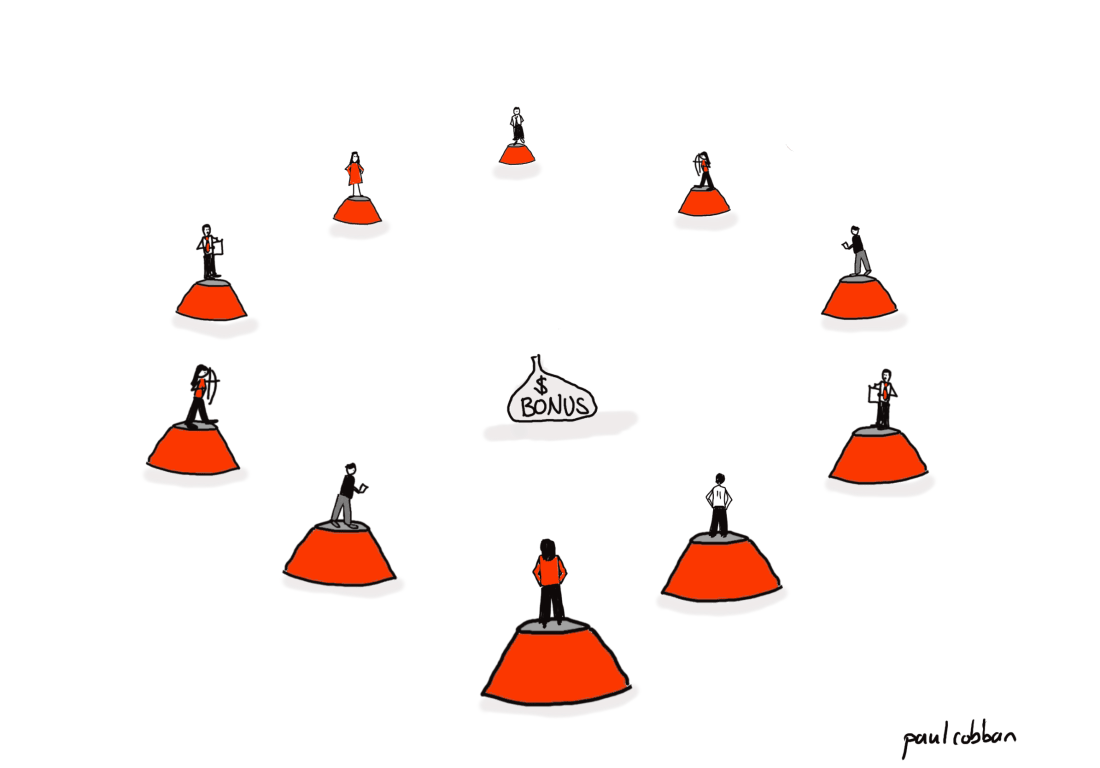
I am all for objective setting as it provides alignment and when used well gives a clear sense of priority.  It allows employees to see how their work fits into the overall purpose of the company. However I do not see individual objective setting as an effective mechanism for driving performance.  In fact I would argue that current practices are counter-productive.  If an employee knows there is a finite number of ratings at each appraisal rating level and there is a fixed bonus pool that will be allocated out based on each rating then they are less not more likely to collaborate for success.  Just like the participants in the Hunger Games someone else’s loss is their gain.

The highest performing teams are typically in sport or the military where teams win or lose collectively and there is far less emphasis on individual performance management.  It is time for corporates to start to rethink how to get the best from their employees collectively.  Leaders need to stop thinking like 19th Century industrialists assuming that workers will try and do as little as possible and start to create environments where everyone can do their best work.

And to my new friends in Africa I would suggest that you should stop trying to emulate Western practices and develop a performance management system that celebrates the African relationships that are at the heart of your culture and not destroy them. Then we can all learn from you.

If you enjoyed this post please do share with your friends and colleagues.

If you would like the my next post delivered to your mailbox please enter your email below
Curiosity Killed the HIPPO

One of the hardest things for leaders to do as they find success in their careers is knowing when to shut up. The more senior a leader becomes, the more the people in their organisation scrutinise their every word and action. Suggestions become commands that quickly cascade throughout the company. A view stated too early in a conversation will close down any contrary views reducing the quality of decisions and ideas. Well intentioned leaders wanting to add improvements to ideas presented to them can destroy the commitment of the person delivering the idea by appearing to make the suggestion their own.

In their defence leaders are expected, by all around them (including themselves) to be the expert in the room. The Highest Paid Person’s Opinion or HIPPO tends to win the day. In our fast changing, complex world where no one person can be the expert in anything, this is increasingly a problem. Mental models that have served us well are no longer relevant. Leaders need to ensure they take advantage of the collective intelligence in the room and fill missing information with data and experimentation. The first step is to listen to others and seek out data before speaking out.  

In his book Rebel Ideas, Matthew Syed talked about the value of having diverse teams so that more is known about problems before deciding on a course of action. The more diverse the team the more diverse the opinions and thought processes are and the better the decision making.  However to allow this diverse collective intelligence to operate, there needs to be an environment where people feel they can air a contrary view without fear of negative consequence.  It is a leader’s role to create such a climate. For many leaders this does not come naturally. Some I speak to who have, shall we say, an “assertive manner” tell me that people need to “just grow a backbone” or “get thicker skin”. This is obviously an attempt to put the blame for the problem that they have created on others.  Leaders should go into decision making processes with intellectual humility and genuine curiosity. Curiosity is the antidote to fear. As a guide there are 3 steps that leaders should take when embarking on a decision making journey.

  1. Assess the dimensions of the problem. Problems and decisions come in all sorts of shapes and sizes. Some require urgent action where there is no time for discussion. Some have critical implications where delegation is not appropriate but a  good proportion are suitable for discussion and are an opportunity for everyone to learn.
  2. Ensure the knowledge in the room is aired. All too often a leader (Boss Bob in the picture above) does not extract the collective intelligence in the room. Not only does Bob think that he understands pretty much everything about the issue in hand, he airs his opinion too early closes down others who have have alternate views and suggestions on how to improve the decision. It is often the quietest person in the room (Introverted Irene) who has the most valuable thing to add but is drowned out by the loudest (Loud Larry) who has an inflated view of their expertise. Like all companies, at DBS we had our share of Bobs, Larrys and Irenes. So we introduced a meeting ritual called Wreckoon. Wreckoon was an idea borrowed from the software developers at Netflix. In order to encourage their developers to write stable code, they introduced software into their data centres to deliberately cause problems, for example intentionly shutting down a server. Netflix named this software chaos monkeys and formed a new discipline called chaos engineering. At DBS our developers did something similar in our data centres but named the software Wreckoon. In order to improve our decision making processes, we had the idea of applying chaos engineering to our meetings to ensure we were maximising collective intelligence and encouraging alternate viewpoints that would be the equivalent of shutting down a server. We mandated that in meetings, there needed to be a “Wreckoon” slide inserted at the most critical point in the associated slide deck. This slide apart from having a cartoon image of Wreckoon would ask questions such as: What have we missed?  What is the contrary view?  When the slide was shown, the chair of the meeting encouraged everyone to answer the questions especially those that had not yet spoken. The results were very positive. In my experience, 90% of the time when we used Wreckoon we got valuable information from the group that we would have not otherwise.  More importantly, Wreckoon became part of the vocabulary.  People would say “I am going to be a Wreckoon here”. This was a signal that someone was going to air a contrary view but with the safety of knowing that the behaviour was to be encouraged.  
  3. Extract the knowledge that does not exist in the room. Not everything can be known before a decision is made but there should be explicit consideration for what is not known and whether there is data or experiments that can fill the gap in the timeframe.  The leader’s role is to encourage the team to experiment and analyse any data. The leader needs to ensure that he/she does blindly overrule the data based on their own potentially outdated mental models. This behaviour is the subject of my next post.

“Intellectual Humility” is the second of the 6 habits required to lead transformation.  My last post covered the first – “Insistence on Improvement”.

If you enjoyed this post and have the “genuine curiosity” to read about the next habit, please leave your email here and my next post will appear in your inbox.

The Fight Against Corporate Inertia

People do not resist change, companies do.

Companies are designed for inertia. They are made up from standard processes to drive productivity and policies to ensure people do not cross lines. We hire people who are like us and place them in an organisational structures where they sit with people with the same skills. We set higher performance targets each year but the default mechanism to achieving them is to work harder rather than change the way we work. To drive improvement in this environment is to push against the very fabric of the organisation and any brute force attempt to do so is destined for failure. Only by systematically addressing each of these components will a climate for change emerge where people can embrace change and sustained transformation becomes possible. In parallel, leaders need to be the enemy of the status quo and create the expectation that improvement across the company is the norm. There are 3 essential areas for leaders to focus on.

Create the expectation to improve

Over a decade ago, when I was studying lean principles, I travelled to Japan on a study trip to tour to and learn from respected manufacturing plants. I was guided round one of the factories by a sensei (quality guru). At one of the stations he stopped, glanced at some documentation displayed and proceeded to scream at the section supervisor in Japanese. Once he had finished he explained to me very calmly that the supervisor had not updated his standard work for 6 weeks meaning that he had not found any improvements on how the job should get done. He added that the role of leaders is to solve problems and drive improvement. Otherwise why did we need leaders? He expected that each supervisor should update their standard work at least weekly. Whilst I did not support his fear-inducing leadership style, his drive of continuous improvement was a light bulb moment for me. The sensei had created an expectation for improvement. He went on to tell me that the 2 most important questions for a leader to ask were firstly “How are you performing to standard?” in other words: given the current resources and processes are you hitting the expected levels of productivity, quality etc. And secondly “What experiments have you run to move to your target state?” You will only be able to improve if you change the way you work – it is not about working harder and this is best achieved through experimentation.

These two questions may seem very operational in nature but they can and should be adapted to all parts of an organisation. People across the company should be rewarded for improving how the job is done not just performing the job.

Create the bandwidth to change and then move to BAU

Back in 2009, shortly after I joined DBS my team ran a programme aimed at taking customer waiting time out of our processes. DBS was known as Damn Bloody Slow since we were famous for long queues at our branches, ATMs and call centres. My team set up a program of process improvement events (PIEs) which were week-long workshops attended by employees who between them knew the target end-to-end process. They physically walked the process identifying issues and then back in the room ideated improvement ideas and implemented as many as possible in the week. In the first year we ran close to 50 PIEs and we dramatically reduced the customer waiting times, taking an estimated 250 million waiting hours out of our processes. We went from the bottom to the top of the customer satisfaction scores in 12 months. The PIE program could only have happened had there been a dedicated transformation team driving it from the centre. The team designed the approach, scheduled the workshops, provided the training, facilitated the sessions and reported on the progress to the CEO. We were highly successful for a couple of years but as focus moved onto the next transformation and since the people participating in the PIEs had day jobs, the focus began to wane. The improvement workshops were seen as one-off exercises. The expectation for improvement was episodic and not continuous.

We realised that we had to embed the need for improvement into BAU. We pivoted the program after a couple of years to replace the workshops with DMS (DBS Management System). Business reviews were no longer conducted in meeting rooms but on the operations floor at visual management boards. Leaders asked a version of the 2 questions from the Japanese sensei – “What are the issues that are preventing you performing to standard levels of quality, productivity and risk?” and “What experiments are you planning to get to the target improved state?”

With this approach the onus was on the leader to walk the floor, to ask the right questions and create the expectation that driving improvement was part of the day job, not a one-off project.

Create a safe environment to challenge

There are points where even the most empowered team feel that they have hit a brick wall. This typically happens when they run into an ingrained corporate habit or out of date policy? Common comments include “We cannot change, it is against the policy” or “our compliance team will never agree”. For people to be able to overcome such situations, it is important to put in place mechanisms to allow anything to be challenged safely. In the PIE program we ensured that there was a compliance person in the PIE team to address concerns early and be part of the solution. Later we set up a Kiasu committee (Kiasu is a Singapore dialect term meaning fear of missing out or to be overly conservative). Anyone could bring a policy to a Kiasu Committee to be reviewed. The committee was chaired by the Compliance head (who dressed up a like a judge and had an over-sized gavel) and made up of a “jury” comprising senior and junior employees who deliberated whether the policy was “guilty” of being Kiasu. If found guilty the process would be amended. The environment was fun and good-natured. In the first year, around 100 policies were challenged with over half being found “guilty” and amended. Quite often the owners of the policies that were deemed to be “not Kiasu” felt that they could improve and amended their policies anyway.

“Insistence on Improvement” is the first of the 6 essential habits of leading transformation. I will be covering the other 5 in coming weeks.

If you enjoyed this article please do leave your email here and my next post will hit your inbox.