A former colleague recently made me aware of a Harvard Business Review article in the latest issue.
It is called “Transformation Should Be a Learning Journey”, written by Evgeny Kaganer and Christoph Loch. The article compares the transformations of DBS and GE and argues that one of the reasons DBS succeeded was because at DBS, we treated transformation as an evolving journey of learning rather than a large project with a predetermined destination and detailed roadmap.
I had two reactions.
The first was that it is always slightly strange reading an academic analysis of something you actually lived through.
The second was: Yes. That is exactly what happened.
Although I am not sure we were clever enough to realise it at the time.
We certainly didn’t have a 13-year transformation plan
I joined DBS in 2009 to lead transformation. At the time the bank was famous in Singapore for being slow, bureaucratic and difficult to deal with. So much so that the initials DBS were jokingly said to stand for “Damn Bloody Slow”.
If you had asked me then to show you the master plan that would eventually take DBS from Damn Bloody Slow to being recognised as the Best Bank in the World, I would have had a problem.
There wasn’t one.
We knew we needed to get better. We had a new CEO, Piyush Gupta, with a strong sense of where the bank needed to go. But we most certainly didn’t know all the steps required to get there.
So we started with the problems immediately in front of us.
Customers were waiting too long.
We learnt from Toyota and introduced process improvement techniques across the bank. We called the programme RED – Respectful, Easy to Deal With and Dependable.
Hundreds of employees became involved. Customer waiting time fell dramatically. Customer satisfaction improved.
And, more importantly, we learnt.
We discovered that fixing internal processes was not enough. Customers didn’t experience our organisation as a series of processes. They experienced journeys.
So we started working on customer journeys.
That taught us something else.
The biggest opportunities to transform those journeys increasingly depended on digital technology. Which led us deeper into digital transformation.
That in turn exposed the importance of APIs, agile working, experimentation, ecosystems and eventually data and AI.
One thing led to another.
Looking backwards, it can look like an elegantly designed transformation strategy.
Living through it felt considerably messier.
And that, I now realise, was one of its strengths.
Direction is more important than a detailed destination
The HBR article makes an important distinction.
Transformations need a compelling vision, but leaders should not pretend that they know precisely what the organisation will look like several years into the future. In a complex and rapidly changing environment that is simply not possible.
Instead, transformation should progressively reveal the destination.
That fits very closely with something I have written about repeatedly since leaving DBS.
In my post The One Big Insight, I argued that:
Companies do not change unless the behaviour of their people changes.
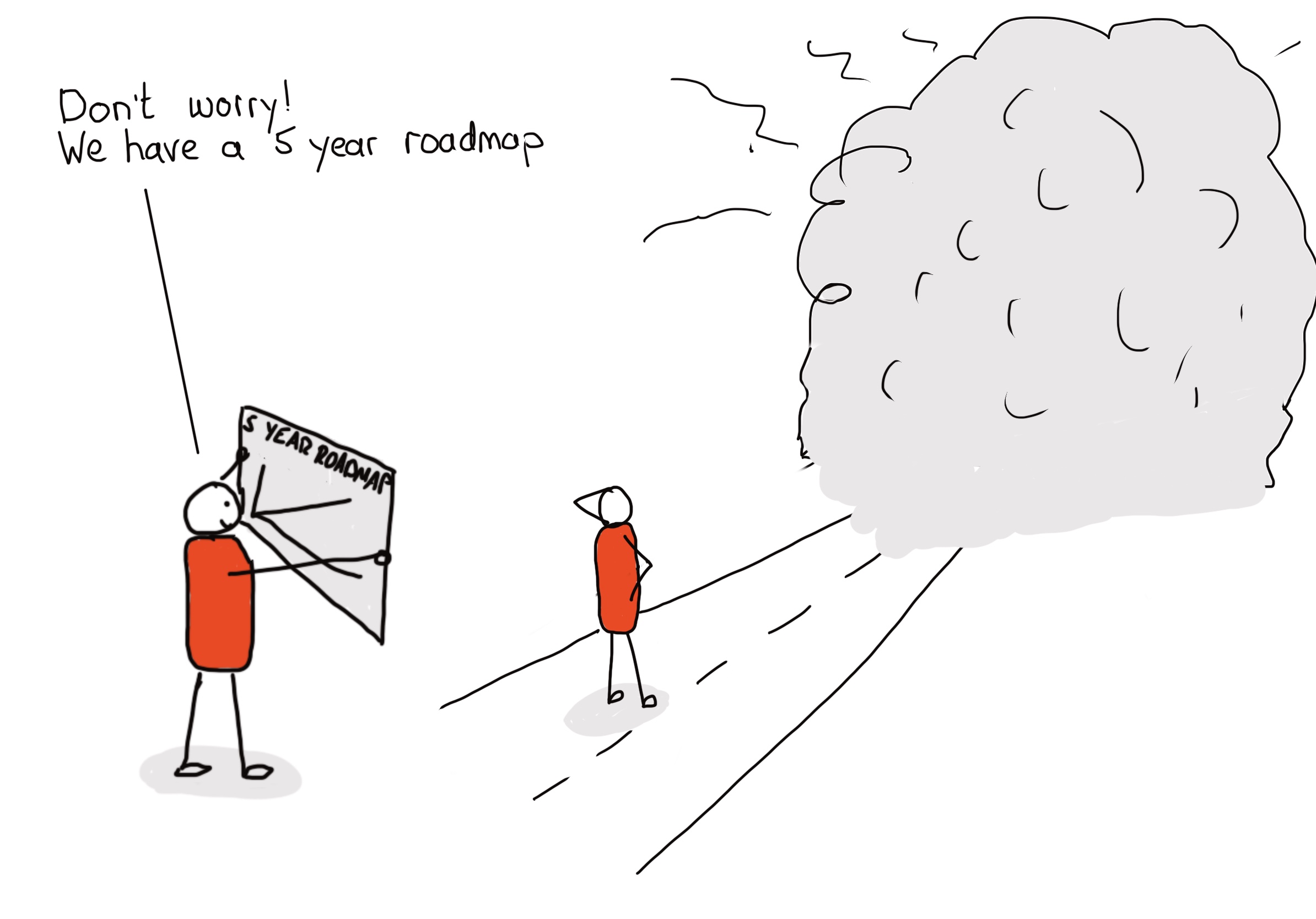
Technology doesn’t transform a company. PowerPoint certainly doesn’t. Nor does a beautifully constructed transformation roadmap.
People do.
The role of leadership is therefore not to design every step of the journey and then persuade thousands of reluctant employees to follow it.
It is to create an environment in which people can move in a common direction, experiment, learn and change their behaviour as they discover better ways of doing things.
That sounds like a subtle distinction.
It isn’t.
It represents a completely different philosophy of transformation.
Type 1 versus Type 2 transformation
I wrote about this in Inciting a Movement.
I described two fundamentally different approaches to transformation.
Type 1 transformations treat the organisation rather like a machine.
Define the target state. Create the business case. Hire consultants. Break the programme into workstreams. Create milestones. Assign KPIs. Track the red, amber and green boxes. Escalate the people who aren’t complying.
The underlying assumption is that senior management knows both where the organisation needs to go and how it should get there.
Type 2 transformations start with a very different assumption.
An organisation is a community of people with knowledge, enthusiasm, experience and ideas. Leadership provides purpose and direction but creates the conditions in which those people can work out much of the route themselves.
The HBR comparison of GE and DBS provides an interesting illustration of the difference. GE’s transformation was much more dependent on a top-down view of where the company needed to go. DBS allowed knowledge generated throughout the organisation to change the direction of the transformation.
That distinction matters enormously.
Because the people closest to the work frequently know things that the executive committee doesn’t.
The transformation roadmap should be flexible
This doesn’t mean transformation should be some sort of corporate free-for-all.
Quite the opposite.
DBS had considerable discipline.
We had a clear vision. We had governance. We measured progress. We deliberately built capabilities. We had a transformation team. We invested significant leadership time.
But we didn’t confuse discipline with certainty.
This is something I explored in my post Being Data Driven.
One of the behaviours we eventually tried to embed at DBS was experimentation.
Instead of leaders always providing answers, we encouraged them to ask questions:
What experiments are you running?
What did you learn from the experiments you ran previously?
The subtle shift is from managing execution against assumptions to managing the rate of learning.
If an experiment proves your hypothesis wrong, that isn’t necessarily failure.
You have learnt something before spending millions of dollars discovering it the hard way.
Unfortunately, many corporate transformation governance systems do exactly the opposite. They punish deviations from the business case and therefore encourage people to conceal evidence that the assumptions behind the business case may have been wrong.
The transformation plan gradually becomes more detached from reality while everyone continues reporting that it is broadly on track.
Build capability before demanding results
Another aspect of the HBR article particularly resonated with me.
Kaganer and Loch describe some transformation investments as “options” – investments that build capabilities the company may need in the future even though there may not yet be a conventional financial business case for them.
That describes much of what we did at DBS.
We taught people customer journey thinking.
We taught experimentation.
We developed agile capabilities.
We developed data skills.
We built APIs before we knew all the things we would eventually do with them.
These investments didn’t always produce an immediate financial return. They gave us the ability to do things we couldn’t previously do. Those capabilities subsequently created options for the next stage of transformation.
This also connects to another of my earlier posts, The Essential Ingredient for a Successful Transformation.
Transformation requires capacity as well as intent.
At DBS we built a relatively small central transformation team. Our job wasn’t to transform the bank on behalf of everyone else. It was to build the methodologies, capabilities and confidence that allowed the bank to transform itself.
The HBR article describes that team rather nicely as an enabler and catalyst rather than the engine of transformation.
I like that description.
People don’t resist change. Companies do.
Perhaps the biggest connection for me is with something I wrote in The Fight Against Corporate Inertia:
People do not resist change. Companies do.
Companies have processes, policies, incentives, organisational structures, budgeting systems and deeply embedded habits designed to make today’s business operate efficiently.
Which is entirely sensible.
Until you want tomorrow’s business to operate differently.
Then those same mechanisms become antibodies attacking the transformation.
This is why telling people to “embrace change” is largely pointless.
Leaders have to change the environment surrounding them.
Give people permission to experiment.
Give them time to learn.
Remove policies that block them.
Change incentives.
Create psychological safety.
Build new capabilities.
Celebrate learning as well as results.
Then something rather interesting happens.
The people supposedly “resisting transformation” frequently become the people driving it.
This matters even more in the age of AI
Which brings me to today.
I see organisations starting to make exactly the same mistake with AI.
They define an AI strategy.
They create a three-year roadmap.
They calculate the expected financial benefits.
They establish an AI programme.
They buy technology.
They train thousands of people.
Then they wait for the productivity improvements to appear.
The problem is that nobody knows precisely how AI will reshape most organisations over the next five years.
The technology is changing too quickly.
Customer behaviour will change.
Regulation will change.
Competitors will do unexpected things.
New business models will emerge.
So perhaps the most important question for leaders isn’t:
“What is our AI transformation plan?”
It is:
“What do we need to learn next?”
What hypotheses should we test?
What capabilities will we need if those hypotheses prove correct?
What are our employees discovering?
And how quickly can those discoveries change what we do next?
Transformation requires confidence and humility
There is a wonderful paradox at the heart of transformational leadership.
People want leaders who appear confident about the future.
But successful transformation requires leaders who are humble enough to admit that they don’t know exactly what that future looks like.
That balance is difficult.
I wrote in The Dangers of Transformation Mountain that transformation leaders need to be able to read changing conditions and adapt their route rather than blindly following the original plan.
Anyone who has spent time in the Scottish mountains knows the danger of deciding on your route in the morning and then refusing to change it when the weather closes in.
Corporate transformation isn’t that different.
You need to know which mountain you are trying to climb.
You need the right equipment.
You need experienced people.
You need discipline.
You need to keep moving.
But occasionally you also need to look up from the map.
The DBS transformation succeeded not because we predicted everything that would happen over the following decade.
We didn’t.
It succeeded because we developed an organisation increasingly capable of learning what to do next.
Perhaps that is the real transformation capability.
Not the ability to execute a plan.
But the ability to continually learn your way towards a better future.
If you enjoyed this post please do share with your friends and colleagues.
If you would like the my next post delivered to your mailbox please enter your email below


